

A law firm website can accumulate hundreds of pages over time: practice-area pages, city pages, blog posts, FAQs, attorney profiles, campaign landing pages, and old announcements. More content does not automatically create more organic growth. When those pages overlap, become outdated, lose relevance, or fail to support a useful client journey, they can make the site harder to manage and harder for search engines and visitors to understand.
A law firm content audit turns that collection into a deliberate system. It evaluates what each URL is supposed to accomplish, whether it still serves that purpose, and what action would improve the site as a whole.
The goal is not to delete every page with low traffic. The goal is to use evidence to decide what should be kept, improved, consolidated, or reviewed for retirement—while protecting valuable URLs, accurate legal information, internal links, and conversion paths.
What Is a Law Firm Content Audit?
A law firm content audit is a page-by-page review of the website’s content and performance. It combines quantitative evidence—such as search impressions, clicks, conversions, and backlinks—with qualitative review of accuracy, search intent, usefulness, overlap, and brand fit.
The audit should answer questions such as:
- Does this page target a clear audience and search intent?
- Is the legal information current and appropriate for the relevant jurisdiction?
- Does the page earn visibility, engagement, links, or qualified inquiries?
- Does another URL serve the same intent better?
- Does the page connect naturally to a practice area, service, or conversion path?
- Would updating this URL be more useful than publishing something new?
A content audit is not a one-click score. It is a decision process. Data tells you where to look; editorial and SEO judgment determine what to do.
Signs a Law Firm May Need a Content Audit
An audit becomes especially valuable when:
- organic traffic or impressions decline across older pages;
- several articles compete for nearly identical queries;
- the site contains outdated statutes, deadlines, procedures, or claims;
- content was published frequently without a keyword map;
- internal links are inconsistent or broken;
- important practice pages receive little support from related articles;
- high-impression pages have weak click-through rates or poor intent alignment;
- the site has changed services, locations, attorneys, or positioning; or
- reporting shows traffic but cannot connect it to qualified inquiries.
These signals do not prove that a page should be removed. They identify where deeper review may create leverage.
Step 1: Build a Complete Content Inventory
Start with a crawl or CMS export that lists every indexable and non-indexable URL you need to evaluate. Include more than blog posts. A useful inventory may cover:
- homepage and core service pages;
- practice-area and sub-practice pages;
- location pages;
- attorney and staff profiles;
- blog articles and guides;
- FAQs and resource pages;
- campaign landing pages;
- archived announcements; and
- duplicate, parameterized, redirected, or orphaned URLs discovered in the crawl.
For each URL, record the current title, status, canonical, indexability, primary topic, intended audience, content type, publication or update date, and owner. Add the page’s main internal links and note whether it is part of an intentional topic cluster.
Do not change slugs, canonicals, redirects, or index settings during inventory work. Those are implementation decisions that require page-level evidence and a reviewed migration plan.
Step 2: Combine Performance and Business Evidence
No single metric should decide a page’s future. Bring together the available evidence from:
- Google Search Console impressions, clicks, click-through rate, and query overlap;
- analytics sessions, engagement, assisted conversions, and landing-page behavior;
- call and form tracking tied to the URL where reliable;
- backlinks and referring domains;
- crawl findings such as broken links, missing metadata, or orphan status;
- CRM or intake outcomes when they can be connected responsibly; and
- internal business knowledge about services, priorities, and client questions.
A low-traffic page may still support a valuable niche service, earn authoritative links, or answer an important client question. A high-traffic page may attract the wrong audience and produce no meaningful next step. Evaluate traffic in context.
After changes go live, the law firm marketing dashboard should make it possible to compare the same evidence over time rather than judging success from a single ranking.
Step 3: Review Search Intent and Topical Fit
Read the page as a prospective client would. What question is the person trying to answer, and does the page answer it directly?
Common problems include an informational article written like a sales page, a service page that spends too long explaining basics without establishing why the firm is relevant, or a general post that targets several unrelated questions and satisfies none of them thoroughly.
Compare the page’s intent with current search results and with other URLs on the same site. If two pages target the same query and serve the same purpose, they may split relevance signals and confuse internal linking. A clear law firm SEO keyword map helps distinguish the primary page for each important intent and reveals gaps that deserve new content.
Step 4: Verify Legal Accuracy and Trust
Legal content needs a higher standard than a typical marketing article. During the audit, flag every precise proposition that could change or vary, including:
- filing deadlines and notice requirements;
- state-specific fault or insurance rules;
- court procedures;
- statutory damages or caps;
- eligibility requirements;
- agency names, forms, and filing instructions; and
- statements about likely outcomes or compensation.
Verify those claims against current statutes, official court rules, government agencies, or other authoritative sources for the relevant jurisdiction. If jurisdiction is unclear, revise the wording so the limitation is explicit rather than presenting a generic rule as universal.
Also check attorney biographies, office information, awards, case outcomes, testimonials, and schema. Do not preserve a trust claim simply because it has been on the site for years. It must still be accurate and supportable.
Changing the publication date without materially reviewing the content is not a meaningful refresh. Update the substance, document the sources, and show the reader why the page is useful now.
Step 5: Identify Cannibalization and Cluster Gaps
Cannibalization is not merely two pages mentioning the same phrase. The real issue is substantial overlap in query, purpose, and audience.
Compare pages that receive impressions for the same queries. Review their titles, headings, conversions, backlinks, internal anchors, and search intent. Then decide which URL should be the primary resource and what role, if any, the other page should play.
A healthy cluster gives each URL a distinct job. The practice page targets commercial intent. Supporting articles answer narrower informational questions and link back naturally. A guide may organize the topic and connect related resources. The topic-clustering framework for law firms can help restructure scattered content into clearer topical relationships.
If two pages are useful but target different stages, differentiate them. If they truly duplicate intent, consolidation may be stronger than rewriting both and leaving them in competition.
Step 6: Assign an Action to Every URL
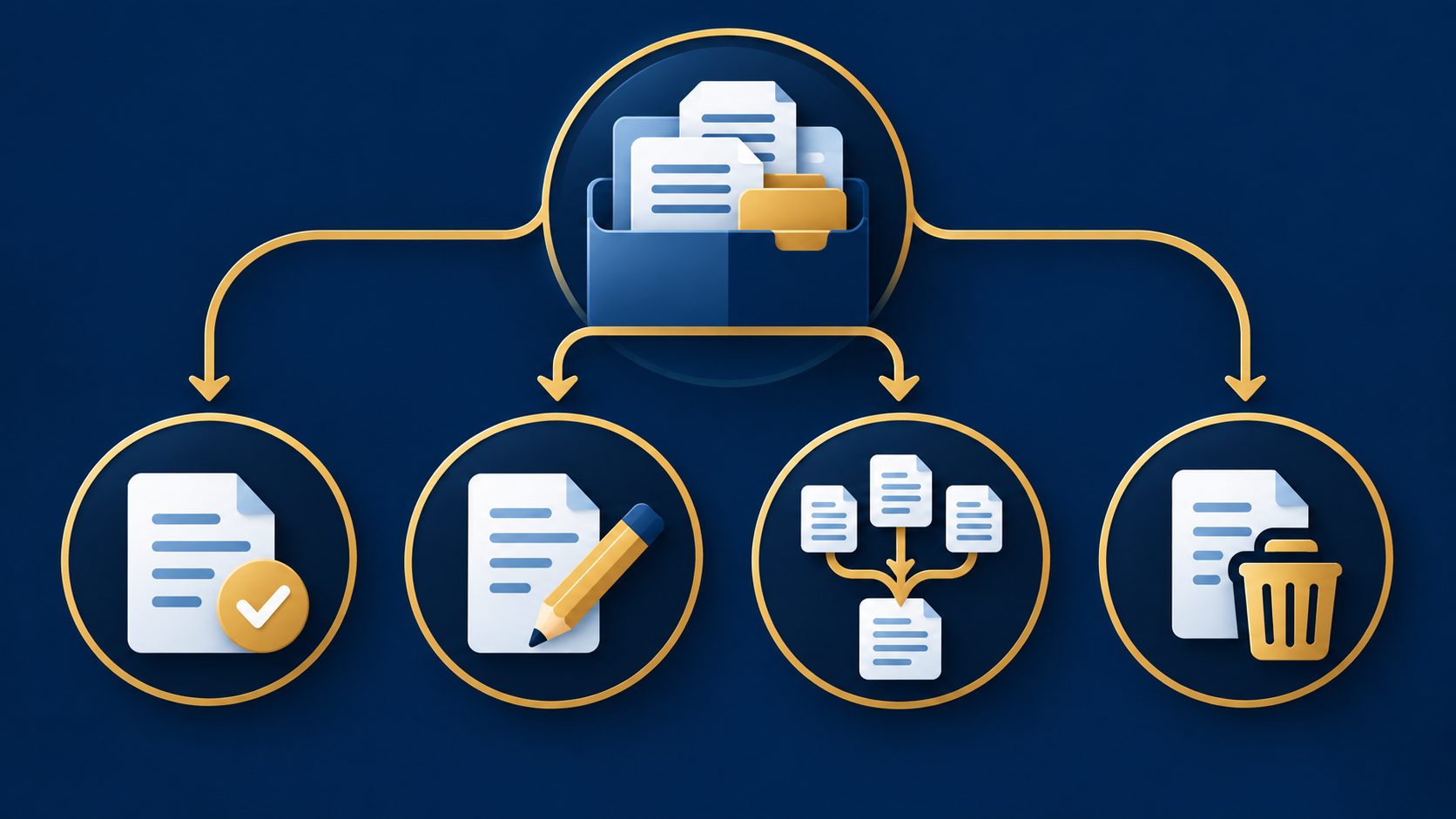
Use a small, consistent set of actions.
Keep
Keep a page when it is accurate, useful, distinct, and aligned with current business goals. “Keep” does not mean ignore forever. Confirm metadata, internal links, conversion paths, and monitoring.
Update
Update a page when the URL and intent remain valuable but the content is outdated, thin, poorly structured, or misaligned with current search results. A substantive update may include reverified legal information, clearer headings, better examples, stronger internal links, improved media, and a more useful CTA.
Preserve the existing URL unless there is a compelling, approved reason to change it. A mature URL may carry history, links, bookmarks, and existing visibility.
Consolidate
Consolidate when two or more pages substantially compete for the same intent and one URL can become the stronger primary resource. Transfer unique, accurate value into the master page before considering any redirect.
Redirects are high-risk production changes. Confirm that the destination is live and intent-matched, document every source and destination, obtain owner approval, and test for chains or loops after implementation.
Review for retirement
A page may warrant retirement when it is obsolete, inaccurate, duplicative, unsupported, and unable to serve a useful purpose through revision. Low traffic alone is not enough.
Before removal, check backlinks, internal links, historic conversions, legal obligations, and whether another page should receive the useful information. Deletion, noindex, canonical changes, and redirects require explicit approval and a rollback-conscious plan.
Step 7: Improve Internal Linking
Internal links should help readers move from a specific question to a broader resource, related issue, or relevant service. They also clarify the relationship among pages.
During the audit:
- identify orphaned pages;
- replace broken or redirected internal links with the final destination;
- link supporting articles to the correct practice or service page;
- add links from established pages to newly strengthened resources;
- use descriptive, natural anchor text; and
- avoid forcing exact-match anchors where they sound unnatural.
Do not add links simply to increase the count. Every link should help the visitor understand or act.
Step 8: Prioritize the Work
A large site cannot be improved responsibly in one bulk edit. Prioritize pages where the expected benefit and evidence are strongest.
A practical first group may include:
- pages with high impressions and weak click-through rates;
- URLs ranking near meaningful visibility gains;
- declining pages with verified, recoverable intent;
- important practice pages with outdated or incomplete coverage;
- pairs with clear query and intent overlap;
- pages with strong backlinks but weak current content; and
- high-traffic pages with no useful internal path or conversion action.
Create a pre-change snapshot for every existing page: URL, title, slug, SEO title, meta description, focus keyword, status, and current copy. That record supports QA and rollback.
Step 9: Measure the Result
Record the implementation date and the exact action taken. Then monitor the same page and query set over a meaningful period, allowing for normal search volatility and crawl timing.
Evaluate:
- impressions and clicks for the intended queries;
- whether the correct URL earns visibility;
- click-through rate changes after metadata improvements;
- engagement with updated sections and internal links;
- qualified calls, forms, or consultations where trackable;
- crawl and indexing status; and
- unintended losses on secondary queries.
Avoid declaring success from a short spike or failure from a few days of movement. Search performance needs context, and conversion improvements may appear on a different timeline from ranking changes.
A Simple Law Firm Content Audit Worksheet
For each URL, document:
- URL and content type
- Intended search intent and audience
- Primary and secondary queries from current evidence
- Organic impressions, clicks, and trend
- Engagement and conversion evidence
- Backlinks and important internal links
- Accuracy and jurisdiction review
- Overlapping site URLs
- Recommended action: keep, update, consolidate, or review for retirement
- Exact changes, owner, risk level, and QA requirements
This worksheet turns the audit into an executable plan rather than a list of observations.
Common Content Audit Mistakes
Deleting pages because they have little traffic
Traffic is only one signal. Check business value, links, relevance, and whether the page supports another conversion path.
Publishing a replacement before reviewing the existing URL
If an existing page already satisfies the intent, strengthen it. Another article may create unnecessary competition.
Treating a new date as an update
Refresh facts, structure, sources, links, and usefulness. A timestamp alone does not improve quality.
Making bulk technical changes without approval
Slug changes, redirects, canonicals, noindex settings, and deletions can create sitewide risk. Review and approve them individually.
Ignoring the intake outcome
Content should not be judged only by traffic. When possible, connect pages to qualified conversations and case opportunities.
Turn Existing Content Into a Stronger Growth Asset
A law firm content audit helps a firm stop guessing which pages need attention. It creates a defensible plan based on search demand, performance, legal accuracy, business value, and the role each URL plays in the site.
The strongest audits protect what already works, improve URLs with real potential, consolidate genuine overlap, and escalate risky removals for approval. They also make future publishing more disciplined because every new page must have a distinct intent and place in the content architecture.
LawProNation connects content strategy, SEO, intake data, internal linking, and conversion reporting so law firms can invest in pages that support qualified growth. To discuss a content and search strategy for your firm, apply for a free discovery call.