
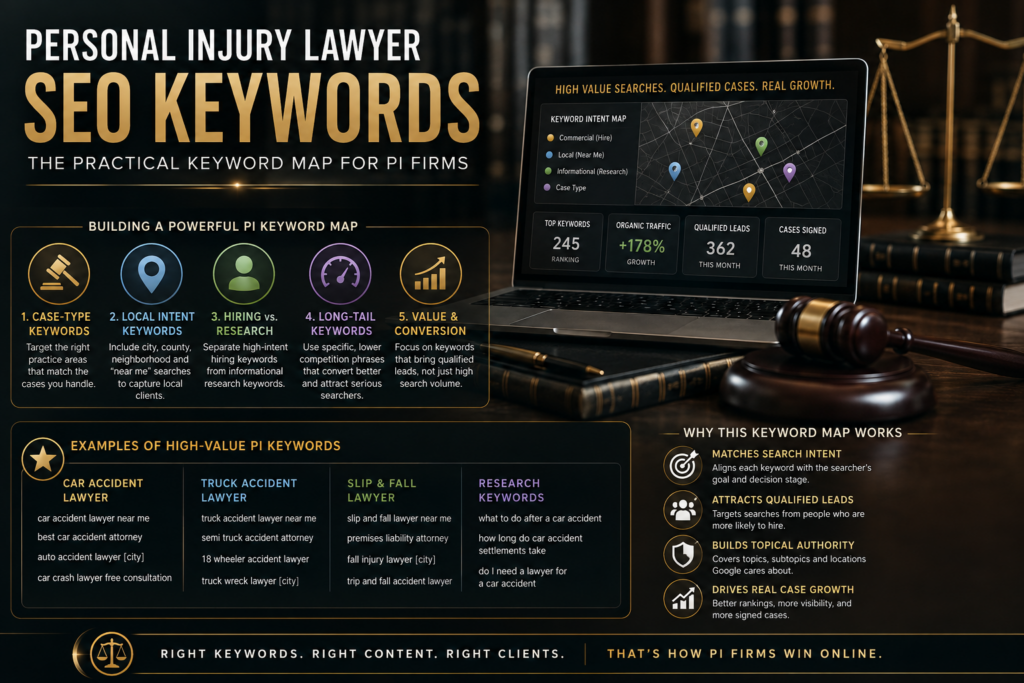
Personal injury lawyer SEO keywords should not be chosen only because they have search volume. For PI firms, the right keyword strategy must consider case type, local intent, urgency, competition, conversion potential, and whether the searcher is actually likely to contact an attorney.
A keyword can look attractive in a spreadsheet and still produce weak leads. Another keyword may have lower search volume but attract people who are closer to hiring. That is why personal injury SEO should be built around intent mapping, not random keyword lists.
Strong SEO for personal injury lawyers should help a firm identify which keywords deserve service pages, which keywords should become blog posts, which keywords support local visibility, and which keywords should be used carefully because they may attract low-quality traffic.
Why PI Keyword Research Is Different
Personal injury SEO is different because the searcher may be under pressure. They may have injuries, medical bills, vehicle damage, missed work, insurance questions, and uncertainty about whether they need a lawyer.
That means the keyword strategy must match the client journey. Someone searching “car accident lawyer near me” is in a different decision stage than someone searching “how long does soreness last after a crash.” Both searches may matter, but they should not be treated the same way.
A serious personal injury keyword map separates keywords by intent. Commercial keywords should usually connect to service pages. Informational keywords should support educational content. Local keywords should support city pages, Google Business Profile strategy, and location relevance.
This is where strong law firm SEO services become important. The goal is not just to collect keywords. The goal is to organize them into a search system that supports qualified case opportunities.
Start With Case-Type Keywords
The strongest PI keyword maps usually begin with case-type keywords. These are the searches that describe the type of accident or injury involved.
Examples may include car accident lawyer, truck accident attorney, motorcycle accident lawyer, pedestrian accident attorney, bicycle accident lawyer, rideshare accident lawyer, slip and fall lawyer, premises liability attorney, dog bite lawyer, wrongful death attorney, and catastrophic injury lawyer.
Each major case type may deserve its own page if the firm wants to attract that work. A firm that handles motor vehicle accidents should not rely on one generic personal injury page. It should have a structure that supports accident-specific search intent.
This is especially true for firms trying to generate stronger MVA leads for attorneys. A person searching for a car accident lawyer is often looking for a more specific answer than a broad personal injury page can provide.
Map Keywords by Local Intent
Most personal injury searches have some kind of local intent. Even when a user does not type a city name, Google may interpret the search locally. That is why PI keyword research should include city, county, neighborhood, and “near me” variations.
Examples include personal injury lawyer near me, car accident lawyer near me, truck accident attorney in [city], motorcycle accident lawyer [city], slip and fall lawyer near me, and best injury attorney in [city].
However, local keyword strategy should be handled carefully. Thin city pages that repeat the same content with different location names can weaken quality. A strong local page should provide real value, useful information, trust signals, and a clear reason for the visitor to contact the firm.
For PI firms, local keywords should work together with service pages, Google Business Profile optimization, reviews, and a strong website experience.
Separate Hiring Keywords From Research Keywords
Not every personal injury keyword shows the same level of buying or hiring intent. A keyword like “best car accident lawyer near me” usually shows stronger hiring intent than “what to do after a car accident.” Both can be useful, but they need different content types.
Hiring keywords should usually be mapped to service pages, landing pages, or local pages. These pages should be conversion-focused and make the next step clear.
Research keywords are usually better for blog posts or resource content. These searches may include questions about insurance, medical bills, fault, police reports, settlement timelines, pain and suffering, and whether a person needs an attorney.
A strong content strategy uses research keywords to build trust and then internally links to commercial pages. For example, an article about accident claim mistakes can link naturally to a car accident service page or to broader personal injury lawyer marketing resources when the audience is attorneys.
Use Long-Tail Keywords to Capture Specific Intent
Long-tail keywords are longer, more specific search queries. They often have lower search volume, but they can reveal stronger intent or clearer context.
Examples include “car accident lawyer for rear-end crash,” “truck accident attorney after commercial vehicle crash,” “lawyer for pedestrian hit in crosswalk,” “do I need a lawyer after a minor car accident,” or “can I sue after a rideshare accident.”
For personal injury firms, long-tail keywords can be valuable because they match real client concerns. They also help support topical authority around a larger case type.
A firm may have a main page for car accident cases, then supporting blog posts about rear-end crashes, distracted driving, hit-and-run accidents, uninsured drivers, rideshare crashes, and rental car accidents. Those supporting articles can internally link back to the main accident page.
Build Keyword Clusters Around Main PI Services
A keyword cluster is a group of related keywords and topics connected to one main service or pillar page. For PI firms, clusters help search engines understand that the firm has depth around a specific topic.
A car accident cluster might include car accident lawyer, rear-end accident, distracted driving crash, uninsured driver accident, accident police report, insurance settlement, rental car after accident, medical bills after accident, and pain after a crash.
A truck accident cluster might include commercial truck crash, semi-truck accident lawyer, trucking company liability, truck driver fatigue, black box data, cargo loading, and federal trucking regulations.
A premises liability cluster might include slip and fall lawyer, grocery store fall, unsafe property, negligent security, wet floor accident, and fall injury claim.
The goal is to build a connected structure where each page supports the others. Strong internal linking helps both users and search engines move through the topic naturally.
Do Not Ignore Conversion Keywords
Some keywords show that the searcher wants to act. These are often connected to free consultations, case evaluations, attorney reviews, best lawyer searches, and near-me searches.
Examples include free consultation personal injury lawyer, injury lawyer free case review, best car accident lawyer near me, personal injury attorney reviews, accident lawyer open now, and personal injury lawyer no fee unless we win.
These keywords should be handled carefully because they can be competitive, but they are often highly valuable. The pages targeting them should be clear, credible, and conversion-focused.
This is why law firm website design matters. A page targeting conversion keywords must be easy to scan, fast on mobile, and built around trust.
Match Keywords to Page Types
A common SEO mistake is using the same page type for every keyword. Personal injury SEO works better when each keyword is matched to the correct page format.
A broad practice keyword may need a main service page. A city keyword may need a local service page. A question keyword may need a blog post. A comparison keyword may need a guide. A paid campaign keyword may need a landing page.
For example, “car accident lawyer in [city]” likely deserves a local service page. “What happens if the insurance check does not cover repairs?” likely deserves an educational article. “Personal injury lawyer near me” may require a combination of Google Business Profile, local SEO, and strong location relevance.
This page-type mapping helps avoid cannibalization. If too many pages target the same keyword, Google may struggle to decide which page should rank.
Avoid Keyword Cannibalization
Keyword cannibalization happens when multiple pages compete for the same search intent. This can split authority and weaken performance.
For example, if a law firm has five blog posts all targeting “car accident lawyer near me,” none of them may perform well. That keyword should probably support a service or local page, while blog posts should target related informational questions.
A personal injury SEO keyword map should clearly identify one primary page for each important commercial keyword. Supporting content should link back to that page instead of trying to outrank it.
This is one reason a specialized law firm marketing agency should build the SEO strategy before content production begins. The content plan should support the site architecture.
Paid Search Data Can Improve PI Keyword Strategy
SEO keyword research should not happen in isolation. Paid search data can reveal which keywords produce calls, forms, and qualified inquiries. That information can improve SEO strategy.
If a Google Ads campaign shows that certain accident keywords produce better leads, those keywords may deserve stronger organic service pages. If paid search reveals that certain terms attract weak or irrelevant inquiries, the SEO plan can avoid over-investing in those topics.
That is why Google Ads for lawyers and PPC for lawyers can support better long-term SEO decisions when they are tracked properly.
The strongest firms use both channels together. PPC gives faster feedback. SEO builds longer-term visibility. Together, they can produce a clearer picture of which keywords actually matter.
Intake Feedback Should Shape Keyword Priorities
Keyword strategy should not only come from SEO tools. Intake feedback is just as important.
Your intake team may know which lead sources produce serious cases, which keywords bring weak inquiries, which questions signal strong case fit, and which prospects need faster follow-up. That information can help shape the SEO roadmap.
For example, if many organic leads mention specific accident types, injuries, or insurance issues, the firm may need stronger content around those topics. If certain pages produce calls but not qualified cases, the page may need better copy, better filtering, or a different keyword target.
Strong legal intake services help connect SEO traffic to real lead quality. That feedback loop can prevent the firm from chasing rankings that do not produce business value.
Build a Practical PI Keyword Map
A practical PI keyword map should include several categories.
Commercial service keywords identify the main cases the firm wants. Local keywords connect those services to target markets. Question keywords support blog and FAQ content. Conversion keywords support contact and consultation pages. Comparison keywords help prospects choose a firm. Retargeting and PPC keywords can support paid campaigns and landing pages.
The map should also assign each keyword to a page. Without that step, the keyword list is not a strategy. It is just a spreadsheet.
A strong PI SEO system should make it clear which pages already exist, which pages need improvement, which new pages should be created, which blog posts should support them, and which internal links should connect the cluster.
Common PI Keyword Mistakes
One common mistake is targeting only the highest-volume keywords. Those terms are often highly competitive and may not be the fastest path to qualified leads.
Another mistake is ignoring long-tail searches. Specific questions and case-type searches can support topical authority and attract more focused visitors.
A third mistake is creating too many overlapping pages. If several pages target the same phrase, the site may compete against itself.
A fourth mistake is writing for keywords without considering intake. A page can rank and still fail if it brings the wrong prospects.
A fifth mistake is failing to connect SEO with PPC, call tracking, lead scoring, and conversion data.
Final Thoughts
Personal injury lawyer SEO keywords should be mapped with precision. The best keyword strategy is not just about volume. It is about understanding case type, location, urgency, search intent, conversion value, and lead quality.
A strong PI keyword map should guide service pages, local pages, blog content, landing pages, internal links, PPC strategy, and intake feedback. When those pieces work together, SEO becomes more than a ranking exercise. It becomes a case acquisition system.
If your firm wants a keyword strategy built around qualified personal injury opportunities, Apply for your FREE Discovery Call with LawProNation.
FAQs
What are personal injury lawyer SEO keywords?
Personal injury lawyer SEO keywords are search terms related to accident cases, injury claims, local attorney searches, legal questions, and hiring intent that PI firms target to improve organic visibility.
What are the best SEO keywords for personal injury lawyers?
The best keywords depend on the firm’s market and case goals, but strong categories include accident type, injury type, local searches, near-me searches, consultation keywords, and client question keywords.
Should PI firms target high-volume keywords first?
Not always. High-volume keywords can be competitive and broad. PI firms should prioritize keywords based on intent, case value, local relevance, and conversion potential.
How do local keywords help personal injury lawyers?
Local keywords help PI firms appear for searches tied to a city, region, or near-me intent. These searches often come from prospects who are closer to contacting an attorney.
What is keyword cannibalization in personal injury SEO?
Keyword cannibalization happens when multiple pages target the same search intent and compete against each other. This can weaken rankings and make it harder for Google to identify the best page.
Can PPC data help with PI SEO keyword research?
Yes. PPC data can show which keywords generate calls, forms, and qualified leads. That information can help prioritize SEO pages and content.
How does LawProNation build PI keyword strategy?
LawProNation maps personal injury keywords by case type, search intent, location, conversion value, PPC data, intake feedback, and internal linking opportunities.