

A law firm answering service is not just a convenience. For growth-focused firms, it can directly affect whether marketing dollars become real conversations, qualified consultations, and signed cases. When a potential client calls and no one answers, that prospect may not leave a voicemail or wait for a callback. They may simply call the next law firm.
That is why missed calls are more than an operations issue. They are a case acquisition problem.
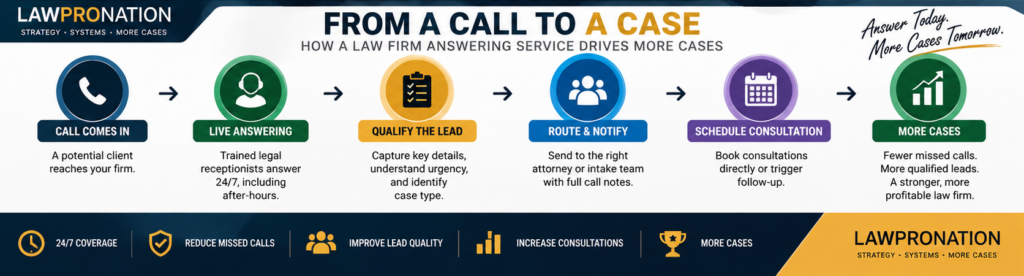
Law firms often invest heavily in SEO, PPC, Google Ads, landing pages, referrals, and lead-generation campaigns. But if calls are missed, routed poorly, or returned too late, the firm loses opportunities it already paid to create. Strong law firm answering service strategy should help protect those opportunities by making sure more calls are answered, captured, qualified, routed, and followed up with.
Why Missed Calls Are So Expensive for Law Firms
A missed call from a potential client is not like a missed call from a vendor. It may be a person who is ready to hire, compare attorneys, ask for help after an accident, discuss an urgent legal problem, or schedule a consultation.
In many legal markets, prospects contact multiple firms. If one firm does not answer, another firm may. The cost is not only the lost call. It is the lost opportunity, the wasted ad spend, the lost consultation, and possibly the lost case.
This is especially important when the call came from a paid source. If a firm pays for PPC for lawyers or Google Ads for lawyers and then misses the phone call, the firm pays for attention but fails to capture the opportunity.
A Law Firm Answering Service Should Do More Than Take Messages
A basic answering service may collect a name and phone number. That is useful, but it is not enough for most law firms.
A stronger answering service should understand call handling, intake routing, qualification, urgency, scheduling, and source tracking. The goal is not simply to say, “Someone called.” The goal is to help the firm understand who called, why they called, how urgent the matter is, whether the lead may be qualified, and what should happen next.
For law firms, every call should have a defined path. Is this a potential new client? Is it an existing client? Is it urgent? Should it be routed immediately? Should it be scheduled for a consultation? Should it be entered into the CRM? Should follow-up be triggered?
A law firm answering service should support that process.
Answering Calls Protects Marketing ROI
Marketing does not end when someone clicks an ad or visits a website. Marketing only creates the opportunity. The phone call is where the opportunity starts turning into revenue.
If a firm is investing in law firm SEO services, organic visitors may call from service pages, blog posts, Google Business Profile, or branded searches. If the firm invests in paid ads, callers may come from campaign-specific landing pages. If the firm uses referral campaigns, callers may already have some trust before they reach out.
Every one of those calls should be captured properly. Otherwise, the firm cannot accurately judge which marketing channels are working.
A campaign may look weak when the real problem is not the campaign. The problem may be unanswered calls, slow callbacks, or no structured intake follow-up.
After-Hours Calls Matter
Legal problems do not always happen during office hours. Accident victims may search at night. Criminal defense prospects may call after an arrest. Family law prospects may reach out after work. Business owners may research legal help early in the morning or over the weekend.
If the firm only answers calls during business hours, it may lose leads that are ready to speak now.
After-hours answering can help protect those opportunities. At minimum, the caller should reach a trained person who can capture contact information, understand the issue, identify urgency, and create a next step.
For personal injury firms, after-hours calls can be especially important because accident prospects may be in the middle of a stressful situation. Strong personal injury lawyer marketing should include a call-response plan that supports urgent inquiries outside normal hours.
Call Answering and Intake Are Connected
A law firm answering service and legal intake are not the same thing, but they should work together.
Answering services focus on making sure calls are answered and captured. Intake focuses on qualification, routing, scheduling, documentation, and follow-up. The strongest system connects both.
For example, a caller may reach the answering service first. The answering team captures the basic details, identifies the type of legal issue, confirms location, determines urgency, and routes the lead into the right workflow. From there, the firm’s intake process can qualify the lead more deeply and schedule the next step.
That is why answering support should connect directly with legal intake services. Calls should not disappear into voicemail, email notes, or disconnected spreadsheets.
Speed-to-Lead Starts With the First Answer
Speed-to-lead is often discussed in terms of callbacks and form follow-up, but it starts with whether the call is answered in the first place.
When someone calls a law firm, they are showing strong intent. They are not just browsing. They are taking action. The faster the firm responds, the better chance it has to guide the conversation.
A law firm answering service helps reduce the delay between interest and contact. Instead of allowing calls to go unanswered during busy periods, lunch breaks, meetings, staff shortages, or after-hours windows, the firm has a system for capturing the lead.
Speed does not mean rushing the caller. It means making sure the caller reaches a trained person who can help move the process forward.
Call Scripts Create Consistency
A strong answering service should use call scripts designed for law firms. The script should not sound robotic, but it should guide the conversation.
A good script may confirm the caller’s name, phone number, email, legal issue, location, urgency, preferred callback time, and how they found the firm. For some practice areas, the script may also ask basic qualifying questions.
For personal injury calls, basic questions may involve accident type, injury status, accident date, location, treatment status, insurance involvement, and whether the caller is already represented.
For attorney-facing LawProNation campaigns, call scripts may focus on practice area, marketing goals, current lead sources, intake challenges, and interest in applying for a discovery call.
The point is consistency. Without a script, every call may be handled differently, and the firm may miss important details.
The Answering Service Should Route Calls Correctly
Not every call should be handled the same way. A potential new client should not be treated like a billing question. An urgent legal matter should not sit in the same queue as a general inquiry. A high-value case signal should not wait until the next day if the firm has escalation rules.
A law firm answering service should know how to route calls based on priority. That may include urgent callbacks, attorney escalation, intake team routing, consultation scheduling, or CRM task creation.
This is especially important for firms investing in MVA leads for attorneys or personal injury leads. Accident-related calls should be captured with the right information and routed quickly so the firm can respond while the prospect’s intent is high.
Call Tracking Should Be Built In
A law firm should know where calls are coming from. Without call tracking, the firm may not know whether a call came from SEO, Google Ads, a landing page, Google Business Profile, a referral campaign, a social ad, or a direct visit.
Call tracking helps connect phone inquiries to marketing sources. But tracking should not stop at call volume. The firm should also review answer rate, missed calls, call duration, lead quality, consultation bookings, and intake outcome.
This is where answering service data becomes marketing data. If one source generates many calls but few qualified consultations, the firm may need better targeting. If another source generates fewer calls but stronger leads, it may deserve more investment.
A law firm answering service should help make call performance visible.
Forms and Calls Should Work Together
Some prospects call. Others submit forms. Many do both. A strong law firm conversion system should connect phone answering with form follow-up.
For example, if someone submits a form and then calls, the intake team should be able to connect those interactions. If someone calls after clicking a paid ad, the firm should know which campaign generated the call. If someone fills out a landing page form after hours, the system should trigger fast follow-up.
Strong law firm landing pages should support both calls and forms. The answering service should then help protect phone-based leads while intake automation protects form-based leads.
Personal Injury Firms Cannot Afford Slow Call Handling
Personal injury prospects often contact firms quickly after an accident or when insurance pressure begins. They may call several firms before choosing who to speak with.
If a PI firm misses calls, delays callbacks, or does not qualify accident leads quickly, valuable opportunities can be lost.
A strong answering process should help identify accident type, injury indicators, treatment status, location, timing, and whether the caller has already hired an attorney. It should also route strong case signals quickly.
For firms investing in SEO for personal injury lawyers, call handling matters because organic rankings can produce more inquiries. The firm must be ready to answer those inquiries when they arrive.
The Answering Service Should Support the CRM
Calls should not live only in notes or email alerts. They should connect to the firm’s CRM or intake system.
A proper call record should include caller details, source, practice area, issue type, lead status, qualification notes, urgency, assigned owner, follow-up task, and outcome when available.
Without CRM discipline, calls can be forgotten. Staff may not know whether a callback happened. Marketing may not know which source produced the lead. Attorneys may not receive enough context before consultation.
A law firm answering service should support clean handoff, not create more disconnected information.
Missed Call Recovery Is Essential
Even with strong coverage, missed calls can still happen. The question is what happens next.
A missed call recovery process should trigger fast callback tasks, call alerts, text follow-up where appropriate, CRM updates, and reporting. The firm should know how many calls were missed, why they were missed, and whether those callers were recovered.
Many firms focus on generating new leads while ignoring missed call recovery. That is a costly mistake. Some of the easiest opportunities to recover are people who already tried to contact the firm.
Reporting Should Show Answer Rate and Outcome
A law firm answering service should provide reporting that helps the firm make better decisions.
Useful metrics may include total calls, answered calls, missed calls, after-hours calls, overflow calls, call duration, source, practice area, qualified lead rate, consultation scheduled, callback required, and outcome.
The firm should not only ask, “How many calls came in?” It should ask, “How many were answered, how many were qualified, and how many moved toward consultation?”
That reporting should connect with broader law firm marketing agency strategy. Marketing, answering, intake, and conversion should operate as one system.
What to Look for in a Law Firm Answering Service
A law firm answering service should understand legal urgency, caller sensitivity, confidentiality expectations, call routing, intake handoff, CRM documentation, and source tracking.
It should also support the firm’s practice areas. A personal injury firm, criminal defense firm, family law firm, immigration firm, and business law firm may all need different scripts and routing rules.
Attorneys should ask whether the answering service can handle after-hours calls, overflow calls, bilingual support where needed, consultation scheduling, custom scripts, urgent escalation, CRM integration, and lead-source tagging.
The answering service should not feel like a generic receptionist. It should feel like part of the firm’s conversion system.
Common Mistakes Law Firms Make With Call Answering
One common mistake is assuming voicemail is enough. Many prospects will not leave a message.
Another mistake is using a generic answering service without legal-specific scripts. That can create weak lead information.
A third mistake is not tracking call source. Without attribution, the firm cannot judge marketing performance.
A fourth mistake is answering calls but failing to qualify them.
A fifth mistake is not routing urgent matters quickly.
A sixth mistake is failing to follow up after missed calls.
A seventh mistake is not reviewing call data regularly.
Final Thoughts
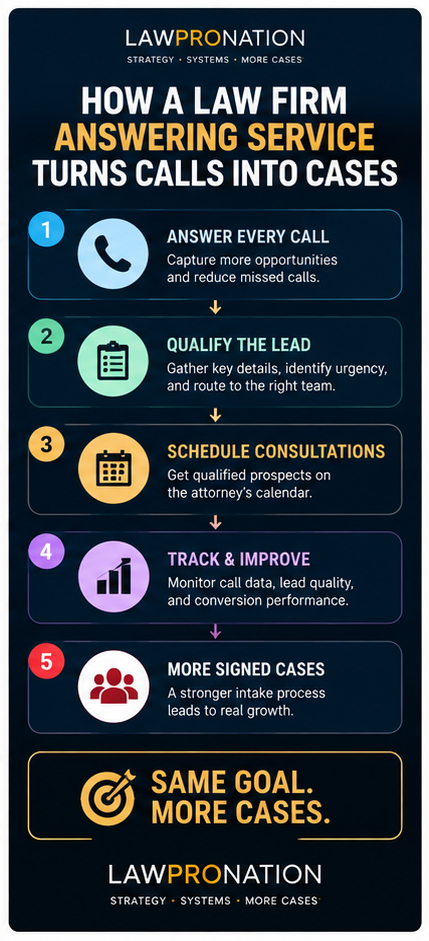
A law firm answering service can protect the opportunities your marketing creates. When calls are answered quickly, captured clearly, routed properly, and connected to intake, the firm has a better chance of converting prospects into consultations and signed-case opportunities.
Missed calls cost more than most firms realize. They waste marketing dollars, weaken response speed, and give competitors a chance to win the conversation first.
If your firm wants fewer missed calls and a stronger call-to-case conversion system, Apply for your FREE Discovery Call with LawProNation.
FAQs
What is a law firm answering service?
A law firm answering service helps attorneys answer calls, capture caller information, route inquiries, support after-hours coverage, reduce missed calls, and help protect potential client opportunities.
Why do law firms need an answering service?
Law firms need an answering service because missed calls can turn into lost consultations and lost cases. A trained answering process helps capture more inquiries and improve response speed.
Is a law firm answering service the same as intake?
No. An answering service focuses on answering and capturing calls. Intake goes deeper into qualification, consultation scheduling, CRM updates, follow-up, and lead conversion. The two should work together.
Should law firms use after-hours answering?
Yes. Many legal prospects call outside normal business hours. After-hours answering can help capture urgent inquiries and prevent leads from going to competitors.
What should a legal answering service track?
A legal answering service should track total calls, answered calls, missed calls, source, practice area, lead quality, routing, consultation scheduling, and callback outcomes.
Does answering service support help personal injury firms?
Yes. Personal injury prospects often contact multiple firms quickly. Fast call answering, qualification, and routing can help prevent valuable accident leads from being lost.
How does LawProNation help with law firm answering systems?
LawProNation connects answering strategy with intake, call tracking, CRM workflows, landing pages, PPC, SEO, lead quality, and the Case Attraction System™.