

Legal intake services can make the difference between a marketing campaign that looks successful and a law firm growth system that actually produces signed cases. A firm may invest in SEO, PPC, Google Ads, landing pages, personal injury leads, referral campaigns, or social media, but if calls are missed or leads are not handled properly, valuable opportunities can disappear quickly.
For many law firms, the problem is not always lead generation. The problem is lead conversion. Calls come in, forms are submitted, prospects ask questions, but the firm does not always respond fast enough, qualify clearly enough, or follow up consistently enough to turn interest into consultations.
That is why strong legal intake services should be treated as part of the marketing system, not just an administrative function. Intake is where traffic becomes a conversation, where a conversation becomes a qualified opportunity, and where a qualified opportunity can become a signed case.
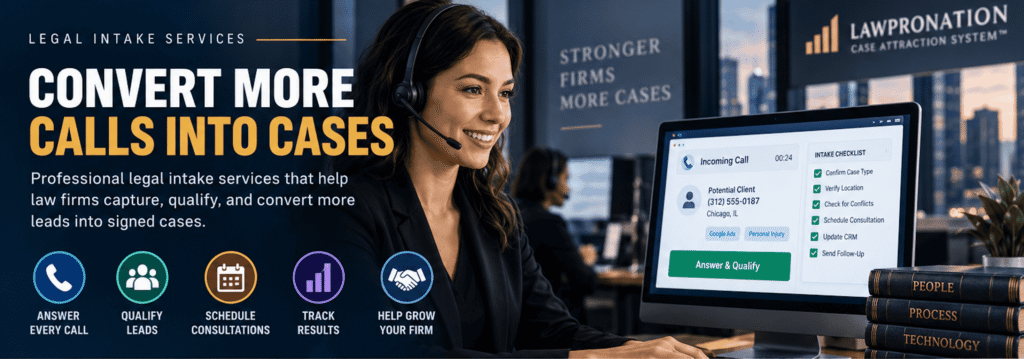
Legal Intake Starts Before the First Call
Many firms think intake begins when the phone rings. In reality, intake begins earlier. It starts with the marketing message, landing page, form, call tracking setup, source attribution, and expectations created before the prospect ever speaks with the firm.
If a paid ad promises fast help but the firm responds hours later, the intake experience breaks the marketing promise. If a landing page asks for a free case evaluation but the follow-up process is unclear, the prospect may move on. If the website generates calls but no one knows which page produced them, the firm loses valuable performance data.
Strong law firm marketing agency strategy should connect marketing and intake from the beginning. The goal is not only to generate inquiries. The goal is to make sure those inquiries are handled in a way that supports case growth.
Missed Calls Are Missed Opportunities
Missed calls are one of the most expensive problems in law firm marketing. A prospect who calls a law firm may be ready to take action. If that call goes unanswered, the prospect may not wait. They may call the next firm listed in Google, click another ad, or respond to a competitor who follows up faster.
This matters across practice areas, but it is especially important in urgent legal categories. Personal injury prospects, criminal defense prospects, employment law prospects, and family law prospects may contact multiple firms in a short period of time.
A strong law firm answering service can help reduce missed calls, after-hours gaps, and slow first response. But answering the phone is only the first step. The call still needs to be qualified, tracked, routed, and followed up with properly.
Speed-to-Lead Matters
Speed-to-lead is the amount of time it takes for a law firm to respond after a prospect calls, submits a form, or requests a consultation. In competitive legal markets, speed matters because prospects often compare several options quickly.
If a form submission sits unanswered, the lead may go cold. If a voicemail is not returned until the next day, the prospect may already have scheduled a consultation elsewhere. If an intake team does not know how to prioritize urgent inquiries, high-value opportunities may be treated like routine admin tasks.
Legal intake services should create a clear response standard. Calls should be answered quickly. Forms should trigger immediate follow-up. Qualified prospects should be routed to the right person. Missed calls should generate callback tasks. Every inquiry should have a next step.
Intake Should Qualify Leads Without Creating Friction
A good intake process should help the firm understand whether a lead is qualified. But it should not feel like an interrogation.
The intake team needs enough information to evaluate the opportunity. Depending on the practice area, that may include case type, location, timing, urgency, opposing party, injury status, insurance details, current representation, budget, or legal need.
For personal injury firms, intake may need to identify accident type, injury signals, treatment status, liability indicators, accident date, location, insurance involvement, and whether the caller has already hired an attorney.
The key is balance. Intake should be structured enough to capture useful information, but simple enough that the prospect feels helped, not blocked.
Intake Scripts Should Guide the Conversation
Law firm intake should not depend entirely on memory or personal style. A consistent intake script can help the team ask the right questions, avoid missing important details, and create a better caller experience.
A script does not need to sound robotic. It should provide structure while still allowing the intake specialist to listen carefully and respond naturally.
A strong script should confirm the caller’s need, collect contact information, identify the case type, ask qualifying questions, explain next steps, and document the source. It should also help the team handle poor-fit inquiries respectfully.
When intake scripts are connected to marketing campaigns, the firm can better understand which sources produce qualified opportunities.
Call Tracking Helps Firms Understand What Works
Law firms cannot improve intake if they cannot see where calls are coming from. Call tracking helps connect phone inquiries to marketing sources, campaigns, landing pages, keywords, and ads.
This is especially important for firms investing in PPC for lawyers or Google Ads for lawyers. Paid campaigns may generate calls, but without tracking, the firm may not know which keywords or landing pages produced the best conversations.
Call tracking should not only measure call volume. The firm should also review call quality, answer rate, missed calls, response time, call duration, and whether the call became a consultation.
A campaign that produces fewer calls but better qualified prospects may be more valuable than a campaign that produces many weak inquiries.
Form Follow-Up Needs a System
Website forms are another major intake point. A form submission should not simply send an email notification and hope someone responds.
A strong intake system should route form submissions quickly, notify the right team member, create a CRM record, trigger follow-up tasks, and confirm that the prospect received a response. The firm should also track which page or campaign produced the form.
This matters for law firm landing pages because landing pages often generate form-based leads from SEO, PPC, retargeting, and referral campaigns. If the page converts but follow-up is slow, performance suffers.
Every form should have a clear process behind it. Who receives it? How quickly should they respond? What happens if the first attempt fails? When does follow-up stop? Those details matter.

Intake Should Connect to the CRM
A CRM can help law firms avoid scattered notes, lost inquiries, and inconsistent follow-up. But the CRM only works if intake uses it properly.
Legal intake services should help ensure that leads are entered correctly, assigned to the right status, tagged by source, qualified consistently, and followed up with on schedule.
Useful CRM fields may include contact details, case type, source, campaign, location, qualification status, consultation date, follow-up status, assigned team member, and outcome.
When CRM data is clean, the firm can make better marketing decisions. It can see which sources produce consultations, which campaigns generate poor-fit leads, and where leads are being lost.
Intake Should Improve Lead Quality Reporting
Marketing reports often show clicks, impressions, traffic, calls, and form submissions. Intake data adds the missing layer: quality.
A law firm should know which leads were qualified, which were not qualified, which became consultations, which did not respond, and which were outside the firm’s target criteria.
This is especially important for firms investing in personal injury leads or MVA leads for attorneys. Accident lead generation should not be judged only by raw volume. The firm needs to understand case type, timing, injury indicators, treatment status, location fit, and follow-up outcome.
Lead quality reporting helps the firm scale the right sources and cut the wrong ones.
Intake and Website Design Work Together
A website can influence the quality of calls and forms before intake ever speaks with the prospect. Clear page copy, strong CTAs, useful FAQs, and focused forms can help pre-qualify inquiries.
Strong law firm website design should support intake by making phone numbers visible, forms easy to complete, service pages clear, and next steps obvious. The website should reduce confusion, not create more work for the intake team.
For example, if a page clearly explains who the firm helps, what services it provides, where it works, and what happens after contacting the firm, prospects are more likely to reach out with the right expectations.
Good design creates better conversations.
Intake Should Support SEO Performance
SEO can increase visibility and traffic, but that traffic needs to convert. If organic visitors call or submit forms and the firm does not respond properly, SEO ROI becomes harder to prove.
Strong law firm SEO services should connect organic performance with calls, forms, consultation requests, and lead quality. Ranking improvements are useful, but the firm should also know which pages are producing real opportunities.
For firms focused on accident cases, SEO for personal injury lawyers should connect to intake feedback. If certain organic pages produce better accident inquiries, those pages may deserve more content, links, or conversion improvements.
SEO becomes more valuable when intake data shows which traffic actually matters.
Intake Should Support PPC Performance
PPC campaigns generate faster data than SEO, but that data can be misleading if intake feedback is missing.
A Google Ads campaign may show conversions, but the intake team may know those conversions were weak. A campaign may have a higher cost per lead but produce better qualified consultations. Another campaign may look efficient but waste staff time on poor-fit callers.
Legal intake services help reveal the difference. Intake feedback can show which campaigns deserve more budget, which keywords should be excluded, and which landing pages need better filtering.
This is how paid search becomes more precise over time.
Follow-Up Is Where Many Leads Are Lost
Not every prospect converts on the first contact. Some miss the callback. Some are still comparing firms. Some need to talk to a spouse or family member. Some are uncertain whether they need legal help. Some are still gathering documents.
If the firm does not follow up, those leads may disappear.
A strong intake process should include follow-up sequences. These may include phone calls, emails, SMS reminders, consultation reminders, and CRM tasks. Follow-up should be professional, timely, and helpful.
The goal is not to pressure the prospect. The goal is to keep the conversation alive and make the next step easy.
After-Hours Intake Can Protect Valuable Leads
Legal issues do not always happen during office hours. Accident prospects may search at night. Criminal defense prospects may call after an arrest. Family law prospects may fill out forms after work. Business owners may research legal help outside normal hours.
If the firm only responds during business hours, it may lose opportunities to firms with faster response systems.
After-hours intake can help capture calls, qualify basic information, and route urgent matters. It can also create follow-up tasks for the next business day.
For competitive practice areas, after-hours coverage can become a meaningful advantage.
Intake Metrics Law Firms Should Track
Law firms should track intake performance with the same seriousness they track marketing performance.
Important metrics may include total calls, answered calls, missed calls, form submissions, response time, callback attempts, consultation requests, show rate, qualified lead rate, lead source, campaign source, practice area, case type, and outcome.
These metrics help the firm understand whether the problem is traffic, conversion, intake, follow-up, or lead quality.
If call volume is high but consultations are low, intake may need improvement. If forms are submitted but response time is slow, follow-up may need tightening. If many leads are unqualified, targeting or landing page messaging may need adjustment.
Common Law Firm Intake Mistakes
One common mistake is letting calls go to voicemail during business hours. Many prospects will not wait.
Another mistake is responding slowly to forms. A form submission should trigger a fast response process.
A third mistake is asking inconsistent qualification questions. Without structure, the firm may miss important details.
A fourth mistake is failing to track lead source. Without source data, the firm cannot judge marketing quality.
A fifth mistake is treating every lead the same. High-value or urgent inquiries may need faster routing.
A sixth mistake is failing to follow up. Many leads need more than one touch.
A seventh mistake is separating intake from marketing. The two should work together.
What Strong Legal Intake Services Should Include
Strong legal intake services should include call answering, form follow-up, lead qualification, source tracking, CRM updates, consultation scheduling, missed call recovery, response-time standards, follow-up workflows, lead scoring, and reporting.
They should also connect with the firm’s marketing channels. Intake should know whether a lead came from SEO, Google Ads, PPC, landing pages, referral campaigns, personal injury lead sources, or Google Business Profile.
The more connected the system is, the easier it becomes to improve both marketing and conversion.
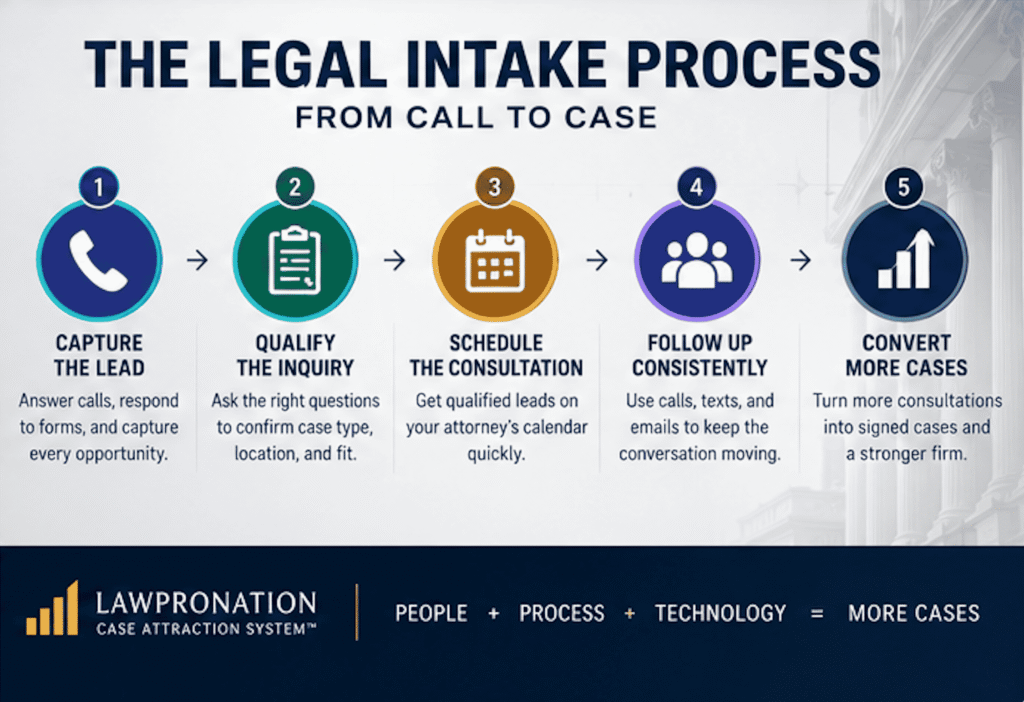
Final Thoughts
Legal intake services are not just an operational support function. They are a core part of law firm growth.
A firm can invest heavily in marketing and still lose opportunities if calls are missed, forms are ignored, leads are not qualified, or follow-up is inconsistent. Strong intake helps turn visibility into conversations, conversations into consultations, and consultations into stronger case opportunities.
If your firm wants to convert more calls and leads into qualified opportunities, Apply for your FREE Discovery Call with LawProNation.
FAQs
What are legal intake services?
Legal intake services help law firms answer calls, respond to forms, qualify leads, track sources, schedule consultations, update CRM records, and follow up with prospects.
Why do law firms need intake services?
Law firms need intake services because marketing only creates opportunities. Intake determines whether calls and forms are answered quickly, qualified properly, and moved toward consultation.
How do intake services improve lead conversion?
Intake services improve lead conversion by reducing missed calls, speeding up response time, asking better qualification questions, tracking lead sources, and creating consistent follow-up.
Should intake connect with law firm marketing?
Yes. Intake should connect with SEO, PPC, landing pages, Google Ads, lead generation, and website tracking so the firm can understand which sources produce qualified opportunities.
What intake metrics should law firms track?
Law firms should track answered calls, missed calls, response time, form submissions, callback attempts, consultation requests, qualified lead rate, source quality, and intake outcomes.
Does intake matter for personal injury firms?
Yes. Personal injury prospects often contact multiple firms quickly. Fast intake response, strong qualification, and consistent follow-up can help prevent valuable accident leads from being lost.
How does LawProNation approach legal intake services?
LawProNation connects intake with marketing, call tracking, landing pages, PPC, SEO, lead quality, CRM workflows, and follow-up as part of a complete Case Attraction System™.