

Law firm landing pages can make the difference between wasted traffic and qualified legal opportunities. A firm may spend money on SEO, PPC, Google Ads, Local Service Ads, social media, or referral campaigns, but if the page does not convert, the marketing system breaks at the most important moment.
A landing page is not just another page on the website. It is a focused conversion asset built for one audience, one intent, and one next step. For attorneys, that next step may be a phone call, consultation request, free case evaluation, contact form, or scheduled discovery call.
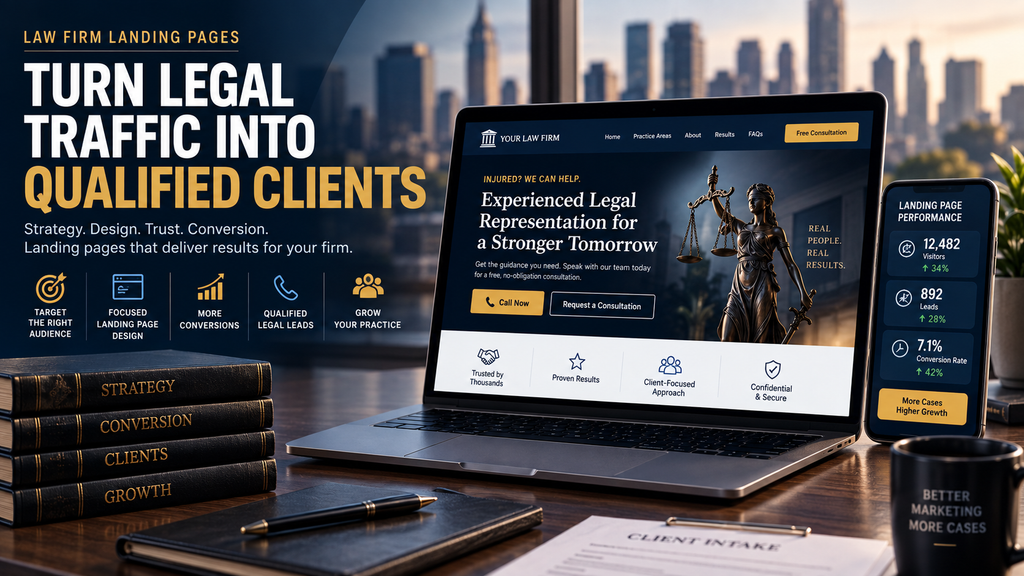
Strong law firm website design should include landing pages that are fast, focused, mobile-friendly, trust-building, and connected to intake. The goal is not only to make the page look professional. The goal is to help the right visitor take action.
What Is a Law Firm Landing Page?
A law firm landing page is a focused page built to convert a specific type of legal traffic. It may support a PPC campaign, Google Ads campaign, SEO topic, referral campaign, lead-generation offer, or local service campaign.
Unlike a homepage, a landing page should not try to explain everything the firm does. It should focus on one clear problem and one clear conversion goal.
For example, a car accident landing page should speak directly to accident victims. A legal intake landing page should speak to law firms missing calls or struggling to qualify leads. A PPC landing page should explain how paid search helps attorneys generate qualified opportunities.
The more closely the landing page matches the visitor’s intent, the stronger the conversion path can become.
Why Law Firm Landing Pages Matter
Legal traffic is often expensive and competitive. Whether a firm is investing in SEO or paid search, every visitor matters. A poorly structured page can waste that traffic by confusing the visitor, failing to build trust, or making the next step difficult.
This is especially important for PPC for lawyers. Paid traffic can become expensive quickly if visitors land on generic pages that do not match the search query. A strong landing page helps protect the budget by improving the chance that high-intent visitors become qualified inquiries.
Landing pages also matter for SEO. A well-built page can support rankings, answer search intent, include internal links, and guide visitors toward conversion. Strong law firm SEO services should consider not only traffic growth, but also whether the landing experience can convert that traffic.
Start With Search Intent
Every law firm landing page should begin with intent. What does the visitor want? What problem are they trying to solve? How urgent is the situation? What would make them trust the firm enough to call or submit a form?
A visitor searching “car accident lawyer near me” has different intent than someone searching “what to do after a car accident.” A visitor clicking a Google Ad for legal marketing help has different intent than someone reading a general blog post about SEO.
Search intent should shape the headline, opening paragraph, offer, proof points, FAQs, CTA, and form fields.
Strong Google Ads for lawyers should connect the keyword, ad copy, landing page message, and intake process. If those pieces do not match, the visitor may leave before converting.
Use One Clear Page Goal
A landing page should have one primary goal. Too many options can weaken conversion.
For a personal injury firm, the goal may be to request a free case evaluation. For a law firm marketing campaign, the goal may be to apply for a discovery call. For a legal intake campaign, the goal may be to schedule a consultation about missed calls and lead conversion.
The page can include supporting links when useful, but the main CTA should remain clear. The visitor should not have to decide between five different actions.
For LawProNation, the strongest CTA is simple: Apply for your FREE Discovery Call. That CTA should appear naturally throughout the page, especially near the top, middle, and end.
The Headline Should Match the Visitor’s Problem
The headline is one of the most important parts of a landing page. It should quickly confirm that the visitor is in the right place.
A weak headline is vague. A strong headline speaks directly to the visitor’s intent.
For example, “Legal Services You Can Trust” is too broad. “Car Accident Lawyer for Injured Drivers in Chicago” is more specific. For a marketing page, “PPC for Lawyers Built to Lower Wasted Spend” is stronger than “Digital Advertising Solutions.”
The headline should be clear before it is clever. Visitors should immediately understand what the page is about and why it matters.
The Opening Section Should Build Immediate Confidence
The first section of a landing page should answer three questions quickly.
What is this page about? Who is it for? What should the visitor do next?
Law firm landing pages should avoid long, generic introductions. The opening should focus on the visitor’s problem, explain the value of taking action, and make the CTA visible.
For paid traffic, this is especially important because the visitor may decide within seconds whether to stay. The page should match the ad promise and reduce friction immediately.
Strong law firm marketing agency strategy should treat landing pages as conversion assets, not just design assets.
Trust Signals Should Appear Early
Legal prospects need trust before they take action. A landing page should show credibility early, not hide it at the bottom.
Trust signals may include reviews, testimonials, case-related experience, attorney credentials, media mentions, awards, years of experience, client results where appropriate, professional associations, security signals, or clear explanations of the process.
For LawProNation pages, trust can also come from clear strategy language, case acquisition positioning, marketing-system explanations, and proof that the agency understands attorney lead quality.
Trust signals should feel relevant and natural. They should support the visitor’s decision rather than clutter the page.
Forms Should Be Short and Useful
A landing page form should collect enough information to start a useful conversation, but not so much that it discourages action.
For consumer-facing law firm pages, a form may ask for name, phone number, email, case type, brief message, and preferred contact time. For a legal marketing page, the form may ask for firm name, website, practice area, current marketing challenge, and contact details.
The right form length depends on the campaign. A shorter form may increase submissions, but a slightly more specific form may improve lead quality.
The key is balance. The form should make it easy for qualified prospects to take action while helping the firm understand what kind of inquiry came in.
Phone Visibility Matters
Many legal prospects prefer to call. On mobile, the phone number should be easy to tap. On desktop, it should be easy to find.
A landing page should not bury the phone number in the footer. It should be visible near the top, repeated where appropriate, and connected to call tracking when the campaign requires attribution.
This is especially important for urgent legal matters and accident-related campaigns. Prospects may not want to fill out a long form. They may want immediate contact.
Phone visibility should work together with legal intake services. If calls come in but are missed or poorly handled, the page’s conversion potential is wasted.
Landing Pages Should Be Mobile First
Many legal searches happen on mobile. A landing page that looks good on desktop but feels clunky on mobile can lose qualified prospects.
Mobile landing pages should load quickly, use clear headings, avoid crowded sections, keep forms simple, make phone numbers tappable, and place CTAs where users can easily find them.
Text should be easy to scan. Buttons should be large enough to tap. Important trust signals should appear before the visitor has to scroll too far.
For personal injury campaigns, mobile experience is even more important. Accident prospects may search from the scene, from home, from a doctor’s office, or while dealing with insurance questions. The page should not add friction.
Match Landing Pages to Campaign Type
Different traffic sources need different landing page strategies.
SEO landing pages often need more educational content, internal links, FAQs, and structured sections because they support organic rankings and user research. PPC landing pages should be more focused and conversion-oriented. Retargeting landing pages may need stronger proof, reassurance, and objection handling. Referral landing pages may need credibility and brand reinforcement.
For firms investing in personal injury lawyer marketing, landing pages may need to be built around accident type, injury concerns, local relevance, urgency, free case evaluation messaging, and intake response.
For marketing-agency pages, the focus may be lead quality, SEO strategy, PPC performance, intake alignment, and predictable growth systems.
Personal Injury Landing Pages Need Extra Precision
Personal injury landing pages should not be generic. A visitor searching for help after a car accident has different concerns than someone searching for a truck accident lawyer, motorcycle crash attorney, or wrongful death lawyer.
A strong PI landing page should address the specific case type, common client concerns, insurance issues, urgency, medical documentation, and the next step. It should also make the consultation process feel simple.
For accident campaigns, landing pages should connect with MVA leads for attorneys and personal injury leads strategy. The page should attract qualified prospects, not just any inquiry.
Lead quality improves when targeting, page copy, form questions, tracking, and intake all work together.

Use FAQs to Reduce Friction
FAQs help answer common objections before the visitor leaves. They also make the page more useful and easier to scan.
A landing page FAQ might answer questions about cost, consultation process, response time, service area, case qualification, PPC pricing, SEO timelines, intake support, or what happens after a form submission.
FAQs should be specific to the page. Generic FAQs are less useful. A PPC landing page should answer PPC-related questions. A personal injury landing page should answer accident-related questions. A legal intake page should answer response and qualification questions.
FAQs can also support SEO when they are written naturally and aligned with search intent.
Internal Links Should Support the Funnel
Landing pages should stay focused, but internal links still matter. They help visitors learn more and help search engines understand how pages connect.
A PPC-related landing page might link to Google Ads for lawyers, law firm PPC services, and law firm SEO services.
A website conversion article should link to law firm website design and legal intake services.
Internal links should be placed naturally. They should help the reader move to the next relevant page, not interrupt the conversion path.
Tracking Should Be Built Into Every Landing Page
A law firm should know what happens after someone visits a landing page. Tracking should show where the visitor came from, which page they landed on, whether they called or submitted a form, and whether the inquiry was qualified.
Important tracking may include call tracking, form tracking, conversion events, source attribution, landing page conversion rate, cost per lead, cost per qualified lead, and intake outcome.
Without tracking, the firm may not know whether a landing page is working. A page may generate traffic but no leads. Another page may generate fewer visits but better qualified inquiries.
Tracking connects marketing activity to business decisions.
Intake Determines Whether the Page Truly Converts
A landing page can generate the inquiry, but intake determines whether the opportunity is handled properly.
If the firm responds slowly, misses calls, fails to follow up, or does not qualify leads consistently, landing page performance becomes harder to judge. A strong page may appear weak because the post-conversion process is broken.
This is why landing page strategy should connect with intake. The form submission, phone call, CRM entry, follow-up task, and lead source should all be connected.
Marketing does not end when the form is submitted. For law firms, that is where conversion continues.
What a Strong Law Firm Landing Page Should Include
A strong law firm landing page should include a clear headline, focused opening section, specific audience targeting, relevant trust signals, simple CTA, visible phone number, short form, mobile-first design, FAQs, internal links, tracking, and intake alignment.
It should also remove unnecessary distractions. Too many menu links, unrelated services, long blocks of generic text, or unclear CTAs can weaken performance.
The page should feel specific to the visitor’s need. A person should not wonder whether the page applies to them.
Common Landing Page Mistakes Law Firms Should Avoid
One common mistake is sending all traffic to the homepage. The homepage is usually too broad for campaign-specific traffic.
Another mistake is using the same landing page for every practice area. Different legal problems need different messaging.
A third mistake is hiding the CTA. Visitors should always know what the next step is.
A fourth mistake is using long forms without a clear reason. Long forms can reduce submissions if they create too much friction.
A fifth mistake is ignoring mobile layout. Many legal visitors are on phones.
A sixth mistake is tracking only total leads instead of qualified leads.
A seventh mistake is building landing pages without intake alignment.
Final Thoughts
Law firm landing pages should be built to convert specific legal traffic into qualified opportunities. They should match search intent, support trust, make action easy, track performance, and connect directly to intake.
A strong landing page does not work alone. It supports SEO, PPC, Google Ads, website design, lead generation, and follow-up. When all of those pieces are connected, a law firm can turn more of its traffic into real consultation opportunities.
If your firm wants landing pages built around legal traffic, lead quality, and conversion, Apply for your FREE Discovery Call with LawProNation.
FAQs
What is a law firm landing page?
A law firm landing page is a focused web page built to convert a specific type of legal traffic into a phone call, form submission, consultation request, or case evaluation.
Why do lawyers need landing pages?
Lawyers need landing pages because campaign-specific pages usually match visitor intent better than a homepage. Better intent match can improve trust, conversion, and lead quality.
Should PPC traffic go to a homepage or landing page?
PPC traffic should usually go to a focused landing page that matches the keyword, ad copy, practice area, location, and CTA. Sending paid traffic to a generic homepage often reduces conversion.
What should be included on a legal landing page?
A legal landing page should include a clear headline, trust signals, strong CTA, visible phone number, short form, mobile-friendly layout, FAQs, tracking, and messaging that matches the visitor’s intent.
How do landing pages improve law firm lead quality?
Landing pages improve lead quality by matching the visitor’s specific problem, filtering poor-fit inquiries, asking useful form questions, and connecting the lead source to intake feedback.
Do landing pages help SEO?
Landing pages can support SEO when they are built with useful content, clear structure, relevant keywords, internal links, FAQs, and strong user experience.
How does LawProNation build law firm landing pages?
LawProNation builds landing pages around legal search intent, SEO, PPC, Google Ads, website conversion, call tracking, intake feedback, and qualified lead generation.