

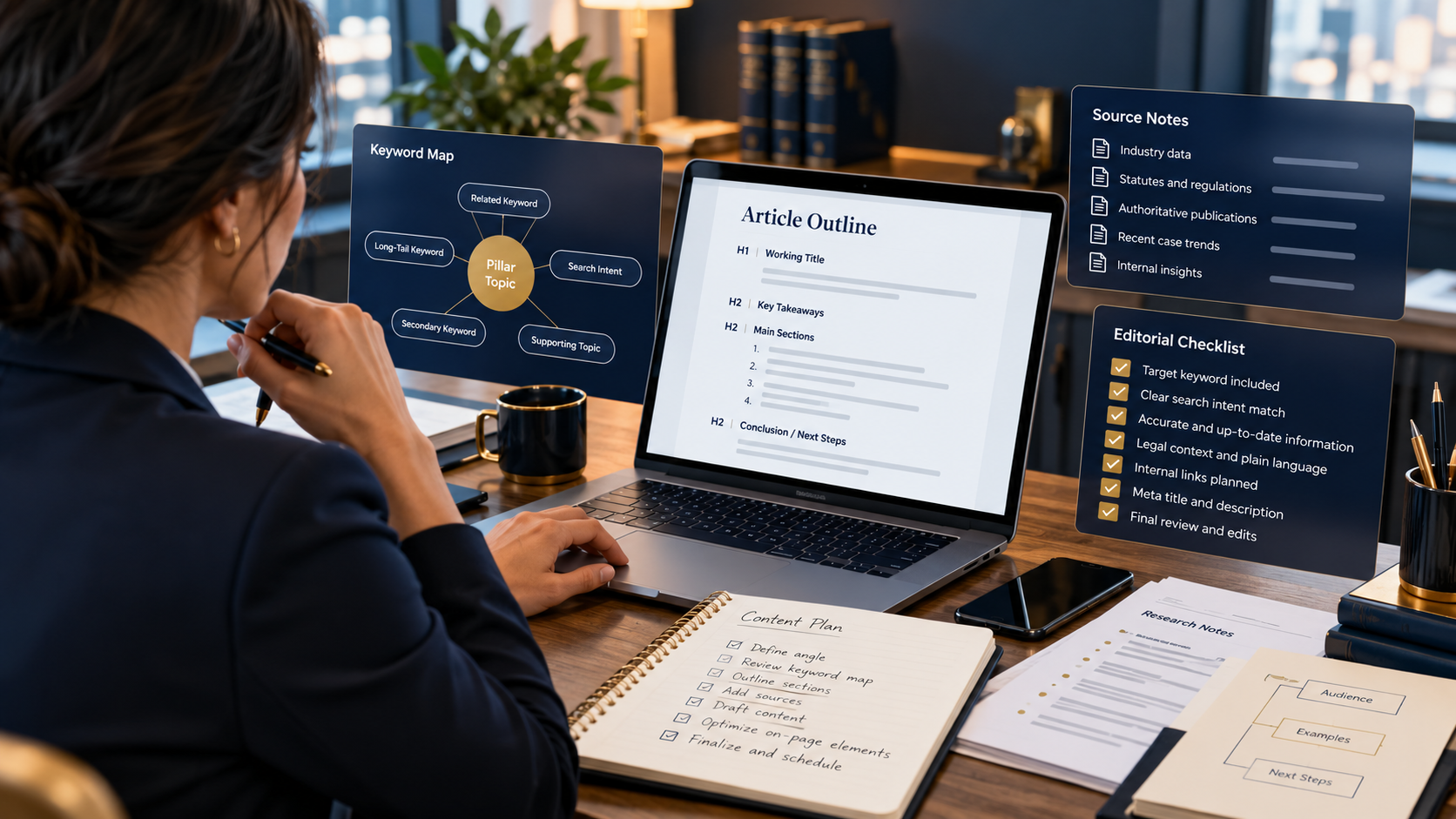
A strong legal article begins before anyone writes the first paragraph. It begins with a clear plan for the reader, the search intent, the facts that require verification, and the action the page should support.
That plan is a law firm SEO content brief. It turns a broad topic into a specific assignment that a writer, attorney reviewer, editor, and SEO specialist can execute consistently. Without one, a draft can sound polished while targeting the wrong question, duplicating an existing page, making unsupported legal claims, or failing to guide the reader toward a useful next step.
This guide explains what every legal content brief should include and provides a practical template your team can reuse.
What Is a Law Firm SEO Content Brief?
A law firm SEO content brief is a set of instructions for creating or substantially updating one page. It defines what the page must accomplish, who it serves, which query it targets, what evidence it needs, how it should be organized, and how it connects with the rest of the website.
It is not a request to “write 1,500 words about car accidents.” Word count does not establish usefulness. A good brief gives the writer enough direction to answer the reader’s real question without padding, drifting into another page’s purpose, or making the content sound interchangeable with every competing article.
The brief should also be distinct from a broader law firm content audit. An audit decides what to keep, update, consolidate, or remove across a site. A content brief plans the best version of one selected page.
1. Define the Reader and Search Intent
Start with the situation that caused the search. Two queries can use similar words while requiring very different pages.
For example, a person searching for the meaning of an insurance term may need a short educational explanation. A person comparing attorneys may need evidence about services, process, qualifications, and next steps. A firm owner searching for marketing help may need a framework, examples, and a way to evaluate potential support.
Record:
- the primary audience;
- what likely happened immediately before the search;
- the question the reader needs answered;
- whether the intent is informational, commercial, navigational, or transactional;
- the appropriate page type; and
- the next reasonable action after reading.
This prevents a common mistake: placing a heavy sales pitch at the top of an urgent informational article or writing an academic guide where the reader needs a service page.
2. Choose One Primary Query and a Focused Supporting Set
The brief should identify one primary keyword that accurately represents the page’s purpose. Secondary phrases should expand the same intent rather than pull the draft toward unrelated subjects.
Before approving the target, compare it with the current site inventory. If an existing URL already satisfies the same intent, improving that page may be safer than creating a competitor. A clear keyword-to-page map helps a firm avoid accidental overlap. Our guide to personal injury lawyer SEO keywords explains how to connect query research with useful pages instead of collecting keywords in isolation.
Record the source and date for every performance metric. If current search volume, clicks, impressions, or rankings are unavailable, label them unknown. A content brief should never convert a guess into a reported fact.
3. State the Page’s Unique Job
Write a one-sentence content purpose that distinguishes the proposed article from related pages.
For example: “This page helps an injured reader evaluate the scope of a medical authorization; it does not provide a complete guide to every stage of an accident claim.”
That boundary keeps the page focused. It also makes internal linking more useful because supporting topics can be introduced briefly and linked to their dedicated resources.
Where several pages support a broader subject, map their relationship through topic clustering for law firms. Each page should have a distinct job while reinforcing the larger topic.
4. Identify Legal Facts and Jurisdiction Limits Before Drafting
Legal content needs a source plan, not just a keyword plan. The brief should flag every proposition that could change by state, court, claim type, or date.
Examples include:
- filing deadlines;
- available damages;
- fault rules;
- insurance requirements;
- procedural requirements;
- exceptions to a general rule; and
- statements about what a lawyer, insurer, court, or agency must do.
For each sensitive point, specify the jurisdiction and the authoritative source to consult. Prefer current statutes, court rules, agency guidance, or other reliable primary sources. If jurisdiction is not known, either omit the proposition or explain the limitation clearly.
The brief should also forbid fabricated case examples, outcomes, settlements, testimonials, reviews, credentials, and statistics. Educational content should not be framed as individualized legal advice.
5. Build the Question and Heading Structure
The H1 should promise a clear outcome that matches the query. The H2 and H3 outline should then follow the reader’s decision sequence.
A useful legal outline often moves through:
- what the issue means;
- why it matters in the reader’s situation;
- what documents or facts to review;
- practical options and tradeoffs;
- mistakes or warning signs;
- jurisdiction-specific limitations; and
- an appropriate next step.
Add the essential questions the article must answer. This gives the editor an objective completion test. It also discourages repeated definitions and generic filler added solely to reach a word count.
6. Set Evidence and Experience Requirements
The brief should tell the writer what support is expected. That may include official sources, existing firm-approved explanations, verified process details, or factual examples that are clearly hypothetical.
It should also identify claims the firm can support about its own service. Do not add awards, results, reviews, attorney qualifications, locations, or response-time promises unless they are visible in an approved source and appropriate for the page.
Useful first-hand insight does not require disclosing confidential matters. A firm can explain how readers should organize documents, what questions commonly create confusion, or how an intake process works—provided those details are accurate and approved.
7. Create an Internal-Link Map
Internal links should help a reader move to the next relevant resource. For every proposed link, record:
- destination URL;
- why it is useful at that point;
- natural anchor text; and
- whether an older page should link back to the new article.
Avoid inserting exact-match anchors mechanically. Also avoid linking to a page merely because it shares a keyword. The destination should answer a follow-up question or support the reader’s next step.
8. Define the Conversion Goal and CTA
Every page should have a primary conversion goal, but the call to action must fit the reader’s stage. A person learning a definition may need a related guide before a consultation. A person dealing with an urgent, fact-specific problem may be ready to speak with someone.
Specify the CTA text, destination, and placement in the brief. For LawPronation content, a relevant final action may be to book a consultation about building a measurable legal marketing system.
Connect the CTA to reporting. A law firm marketing dashboard should distinguish page visits and form submissions from qualified case or consultation opportunities.
9. Add Metadata and Image Requirements
Provide a proposed slug, SEO title, meta description, category, useful tags, and image plan. The SEO title should communicate the page’s benefit without forcing every secondary keyword into it. The meta description should set an accurate expectation rather than make unsupported promises.
For images, define the purpose, dimensions, filename, and ALT text. A feature image should establish context. An inline diagram should make a process or decision easier to understand. ALT text should describe the image—not repeat a keyword unnaturally.
Law Firm SEO Content Brief Template
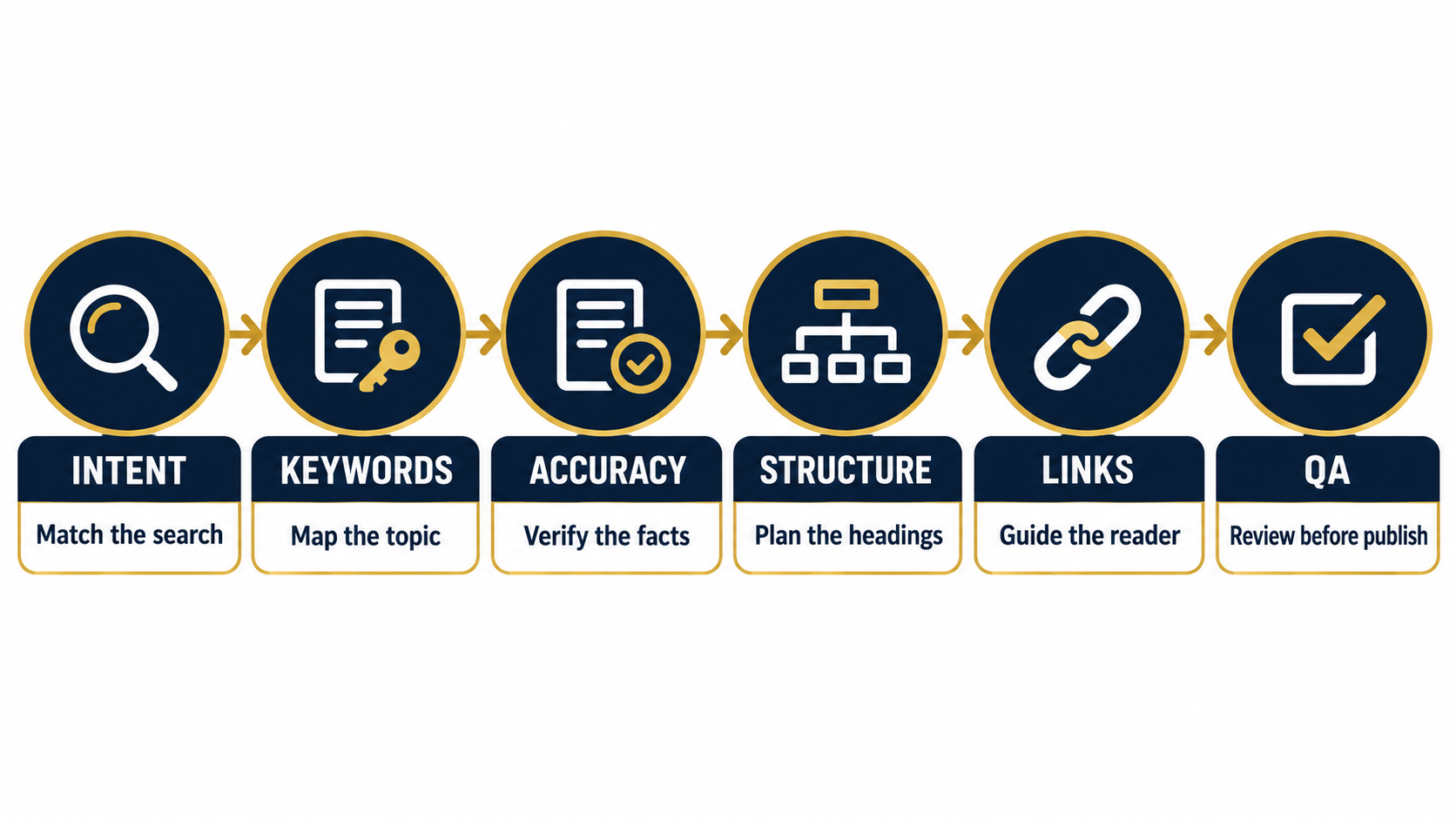
Use this compact structure for each assignment:
- Page title/H1:
- Existing or proposed URL:
- Audience and triggering situation:
- Primary search intent:
- Primary keyword:
- Secondary phrases:
- Metric sources and date checked:
- Existing competing URL:
- Unique page purpose:
- Questions the page must answer:
- H2/H3 outline:
- Jurisdiction and legal-fact notes:
- Required authoritative sources:
- Claims or examples to avoid:
- Internal links and anchor rationale:
- Primary CTA and destination:
- SEO title and meta description:
- Feature and inline image requirements:
- Reviewer and approval path:
Final Editorial and SEO QA
Before publishing, confirm that the draft answers the stated intent, uses the assigned URL, and does not duplicate another page. Verify important facts against the sources named in the brief. Check headings, links, images, metadata, canonical URL, and indexability. Remove placeholder text, unsupported claims, visible drafting instructions, and needless repetition.
Finally, open the public URL. Confirm that the correct page loads on the correct domain, links and images work, the layout remains usable on mobile, and no unexpected noindex or canonical value appears.
A Better Brief Produces a Better Legal Article
A law firm SEO content brief is not bureaucracy. It is a quality-control tool. It helps a firm decide what a page is for before spending time writing, reviewing, and publishing it.
The best brief connects the reader’s question with a distinct page purpose, defensible legal information, a useful structure, relevant internal resources, and a measurable next step. When those decisions are made up front, the finished article is easier to write, safer to review, and more useful to the people it is meant to serve.