

Digital marketing for law firms is not just about getting more traffic. It is about building a system that attracts the right prospects, earns trust, creates inquiries, qualifies leads, and helps the firm turn more opportunities into consultations and signed cases.
Many attorneys invest in digital marketing one channel at a time. They hire one company for SEO, another for paid ads, another for website work, and another for answering calls. The problem is that disconnected marketing often creates disconnected results. Traffic increases, but lead quality does not. Ads generate calls, but intake misses them. Blog posts get published, but service pages do not rank. The website looks better, but conversion stays weak.
A stronger approach connects SEO, PPC, website design, landing pages, intake, tracking, and follow-up into one growth system. That is where a specialized law firm marketing agency can help attorneys move beyond isolated tactics and build a more complete client acquisition strategy.
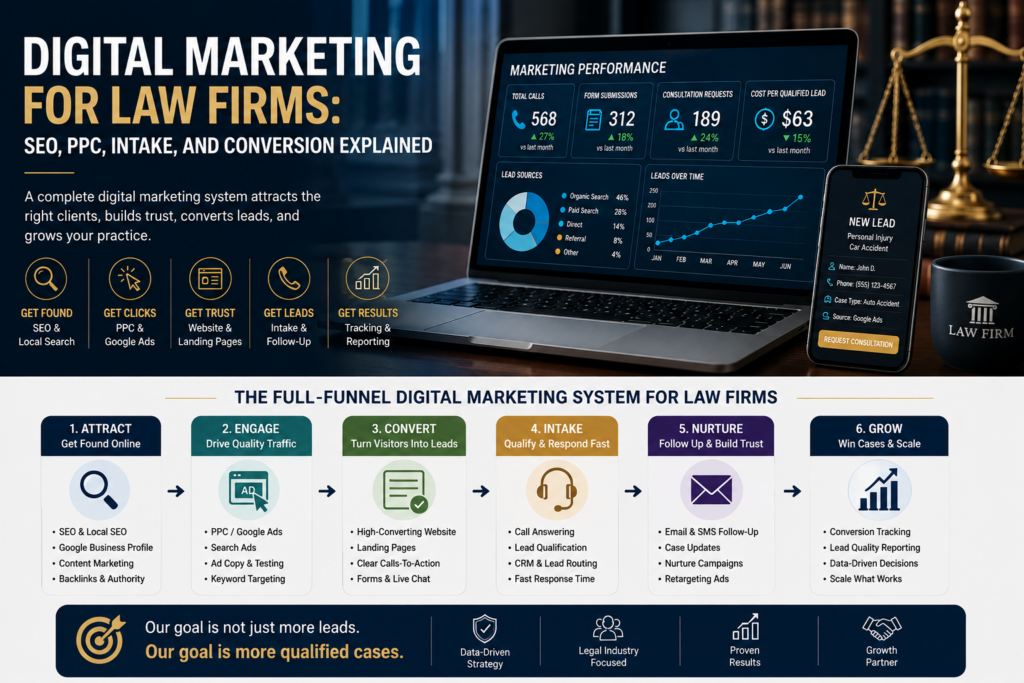
Digital Marketing Starts With the Client Journey
Before choosing channels, a law firm should understand how prospects actually make decisions. A potential client may search Google, click an ad, read reviews, compare websites, visit a service page, submit a form, call after hours, or return days later after seeing another touchpoint.
That journey is rarely linear. Some people are ready to hire immediately. Others need education before they trust a firm. Some compare several attorneys before contacting anyone. Others submit a form and then disappear if the firm does not respond quickly.
Digital marketing for law firms should be built around that journey. The goal is to create visibility when prospects search, credibility when they compare, clarity when they land on the website, and fast response when they take action.
SEO Builds Long-Term Search Visibility
SEO is one of the most important foundations of law firm digital marketing. Strong law firm SEO services help attorneys appear when prospects are searching for legal help, practice-area information, local attorneys, and answers to urgent legal questions.
Law firm SEO should include keyword research, service page optimization, local SEO, technical SEO, internal linking, content strategy, Google Business Profile alignment, metadata improvements, schema, and performance tracking.
The most important SEO assets are often the firm’s service pages. These are the pages that target high-intent searches and explain what the firm does. Blog posts can support SEO, but they should not replace strong commercial pages.
For personal injury firms, SEO needs even more precision. Accident-related searches are competitive, local, and often tied to high-value cases. A firm targeting auto accidents, truck accidents, motorcycle accidents, or serious injury cases needs a dedicated strategy around SEO for personal injury lawyers rather than generic legal content.
PPC Creates Faster Visibility
SEO takes time. PPC can create faster visibility for high-intent searches, especially in competitive markets where organic rankings are still developing.
Strong PPC for lawyers should not be measured only by clicks or impressions. For law firms, paid search should be measured by qualified calls, form submissions, consultation requests, cost per qualified lead, and eventual case opportunities.
A serious PPC strategy should include careful keyword targeting, negative keywords, ad copy testing, landing page alignment, call tracking, form tracking, conversion review, and lead quality feedback. Without those pieces, a campaign can spend money quickly without producing useful results.
Paid search is especially useful when a firm needs immediate demand capture. But it should not operate separately from the rest of the marketing system. PPC insights can help improve SEO pages, landing pages, messaging, and intake scripts.
Google Ads Should Match Legal Intent
Many law firms run Google Ads but send traffic to generic pages. That often hurts conversion because the landing page does not match the searcher’s intent.
A person searching for a car accident lawyer should not land on a broad homepage with unclear messaging. A person searching for legal marketing support should not land on a generic agency page that does not explain law firm-specific strategy.
Strong Google Ads for lawyers should connect the keyword, ad message, landing page, offer, call tracking, and intake process. Every step should feel consistent to the visitor.
The more closely the campaign matches the prospect’s need, the better chance the firm has to convert the click into a qualified opportunity.
Website Design Affects Every Channel
A law firm website is the center of the digital marketing system. SEO traffic, PPC traffic, referral traffic, retargeting, social traffic, and branded searches often lead back to the website.
That means law firm website design is not just about appearance. It directly affects conversion, trust, usability, tracking, and lead generation.
A strong law firm website should have clear headlines, focused service pages, mobile-friendly layouts, fast loading speed, visible calls to action, trust signals, reviews, attorney credibility, FAQs, simple forms, and easy phone access.
If the website is confusing, slow, thin, or generic, the firm may lose leads even when marketing campaigns are generating visibility.
Landing Pages Improve Campaign Performance
Landing pages are especially important for paid campaigns. A homepage usually has too many distractions. A focused landing page can match the search intent more directly and guide the visitor toward one clear action.
A strong legal landing page should explain the problem, identify who the service is for, build trust, answer common objections, and make the next step simple. It should include a clear phone number, short form, strong CTA, trust signals, and mobile-first layout.
For personal injury firms, landing pages may need to focus on accident type, urgency, free case evaluation, response speed, and qualification. For marketing services, landing pages may need to explain strategy, services, lead quality, intake, and growth systems.
Landing pages also make tracking easier. The firm can see which campaigns and messages produce better leads.
Intake Is Where Marketing Becomes Revenue
Digital marketing does not end when a lead comes in. For law firms, that is where conversion begins.
If calls are missed, forms are ignored, leads are not qualified, or follow-up is slow, the firm may waste opportunities it already paid to generate. This is why legal intake services should be part of the digital marketing conversation.
A strong intake system should include fast response, clear qualification criteria, call tracking, form routing, CRM usage, follow-up reminders, consultation booking, and source attribution.
Many firms do not have a traffic problem. They have a conversion problem after the inquiry arrives. Improving intake can often increase results before increasing ad spend.
Lead Quality Matters More Than Lead Count
More leads do not always mean better growth. A campaign can generate many inquiries that are outside the practice area, outside the service region, too small to pursue, already represented, or not serious.
Digital marketing for law firms should measure lead quality, not only lead volume. The agency and firm should review which sources produce qualified consultations, which campaigns create weak inquiries, and which pages attract better prospects.
This matters especially for firms investing in personal injury leads or MVA leads for attorneys. Accident lead generation should be judged by relevance, timing, qualification, exclusivity, and signed-case potential.
A smaller number of better leads can be more valuable than a larger number of poor-fit inquiries.
Tracking Connects the System
Tracking is what turns digital marketing from guesswork into strategy. Without tracking, the firm may know that calls increased, but not which pages, ads, keywords, or channels produced them.
Important tracking may include organic traffic, keyword rankings, Google Business Profile activity, paid search performance, cost per lead, cost per qualified lead, call recordings, form submissions, consultation requests, source attribution, landing page conversion rate, and intake outcome.
The goal is not to create a complicated dashboard for its own sake. The goal is to identify what is working, what is wasting budget, and where the next improvement should happen.
A law firm should be able to see the connection between marketing activity and real business opportunities.
SEO and PPC Should Inform Each Other
SEO and PPC often perform better when they share data. Paid search can reveal which keywords convert quickly. SEO can then prioritize organic pages around those proven topics. SEO content can also improve landing page quality, trust, and long-term visibility.
If a paid campaign shows that a certain service, location, or message produces better qualified leads, the SEO strategy should consider building or improving content around that insight. If organic pages produce strong leads, those same topics may deserve paid campaign support.
The strongest digital marketing systems do not treat SEO and PPC as rivals. They use both channels to learn faster and grow smarter.
Content Should Support Search, Trust, and Conversion
Content marketing is useful when it supports the full funnel. Blog posts should not be written only to fill a publishing schedule. They should answer real questions, support service pages, build authority, and help prospects move toward action.
A law firm content strategy should include educational articles, comparison posts, FAQs, service-page support, local relevance, and internal links. Each piece should have a purpose.
For example, a blog post about choosing a law firm marketing partner should link to relevant service pages. A post about paid search should connect to PPC and Google Ads pages. A post about intake problems should connect to intake services.
The goal is to build a connected content ecosystem that supports both rankings and conversion.
Local Visibility Still Matters
Even in a broader digital strategy, local visibility remains critical for many attorneys. People often search for lawyers near them or in a specific city, county, or region.
Local SEO may include Google Business Profile optimization, reviews, local service pages, business listing consistency, location-specific content, and local internal linking. For law firms, reviews and profile quality can influence whether a prospect calls before they ever visit the website.
Local visibility should not be separated from SEO, PPC, and intake. A firm may rank locally and still lose the lead if the website is weak or the intake process is slow.
Reporting Should Explain What to Do Next
A digital marketing report should not just list metrics. It should explain what the metrics mean and what should happen next.
A useful report should show visibility, traffic, rankings, ad performance, calls, forms, consultation requests, landing page conversion, source quality, and lead quality. It should also identify priorities for the next period.
For example, if PPC is generating calls but few qualified leads, the campaign may need keyword refinement or better qualification. If SEO traffic is growing but conversions are flat, the site may need stronger CTAs or better service pages. If leads are coming in but not booking, intake may need improvement.
Good reporting should lead to better decisions.
Common Digital Marketing Mistakes Law Firms Should Avoid
One common mistake is treating each channel separately. SEO, PPC, website design, intake, and tracking should work together.
Another mistake is focusing only on traffic. More visitors do not help if they are not qualified or if the website does not convert them.
A third mistake is sending paid traffic to weak pages. Campaigns need landing pages that match search intent.
A fourth mistake is ignoring intake. Slow response and poor follow-up can waste expensive leads.
A fifth mistake is judging success only by lead count. Lead quality, consultation rate, and signed-case potential matter more.
Final Thoughts
Digital marketing for law firms works best when every part of the system is connected. SEO builds long-term visibility. PPC creates faster demand capture. Website design supports trust and conversion. Landing pages match campaign intent. Intake turns inquiries into consultations. Tracking reveals what deserves more investment.
The goal is not simply to get more traffic or more leads. The goal is to attract the right prospects, convert more of them, and build a more predictable path from first click to qualified consultation.
If your firm wants a connected digital marketing system built around qualified legal opportunities, Apply for your FREE Discovery Call with LawProNation.
FAQs
What is digital marketing for law firms?
Digital marketing for law firms is the use of SEO, PPC, website design, landing pages, content, local SEO, intake, tracking, and follow-up to attract and convert potential legal clients.
Do law firms need both SEO and PPC?
Many law firms benefit from both. SEO builds long-term organic visibility, while PPC can create faster traffic for high-intent searches. Together, they can support a stronger acquisition system.
Why does intake matter in law firm digital marketing?
Intake matters because marketing only creates opportunities. The firm must respond quickly, qualify leads properly, and follow up consistently to turn inquiries into consultations.
What should law firms track in digital marketing?
Law firms should track rankings, traffic, paid search performance, calls, forms, consultation requests, landing page conversions, lead source, response time, and lead quality.
How does website design affect law firm marketing?
Website design affects trust, usability, SEO performance, mobile experience, landing page conversion, form submissions, phone calls, and overall lead generation.
Are more leads always better for attorneys?
No. More leads are only useful when they are qualified, relevant, timely, and aligned with the firm’s practice areas, geography, and case goals.
How does LawProNation approach digital marketing for law firms?
LawProNation connects SEO, PPC, website design, landing pages, intake, tracking, lead quality, and follow-up into a Case Attraction System™ for growth-focused law firms.