

Law firm intake services can determine whether a lead becomes a real opportunity or disappears before an attorney ever reviews the case. A law firm may invest heavily in SEO, PPC, landing pages, Google Ads, referrals, or purchased leads, but if intake is slow, inconsistent, or poorly tracked, marketing performance will suffer.
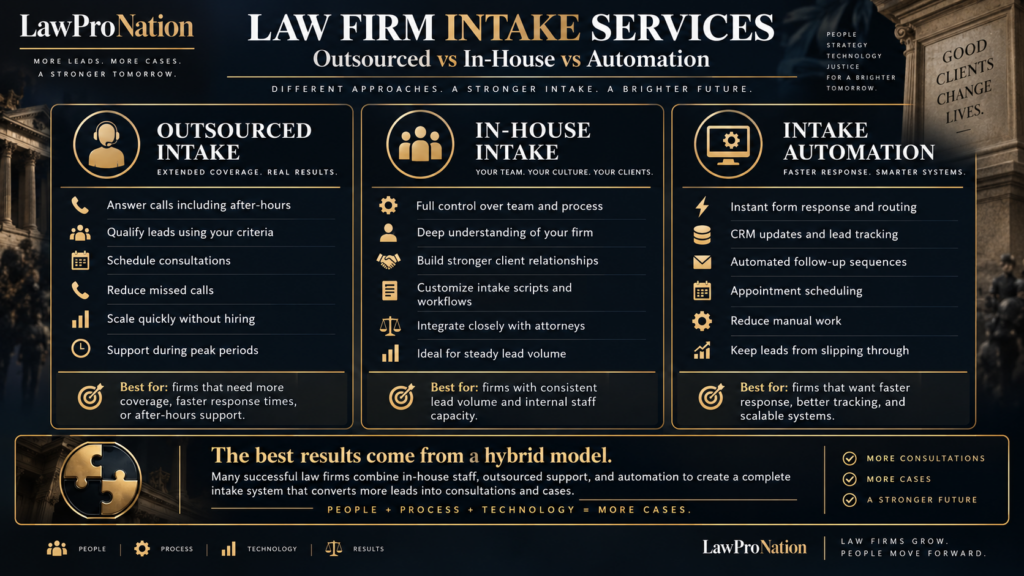
The challenge is that there is no single intake model that works for every firm. Some law firms need an in-house intake team. Some need outsourced intake support. Some need automation. Many firms need a hybrid system that combines people, process, and technology.
Strong legal intake services should help law firms answer calls, respond to forms, qualify leads, schedule consultations, track sources, update CRM records, and follow up consistently. The right model depends on volume, practice area, budget, urgency, staffing, and growth goals.
Why Intake Structure Matters
Intake is not just administrative support. It is part of the law firm’s client acquisition system.
When someone contacts a law firm, they may be comparing several options. They may call one firm, submit a form to another, and schedule a consultation with whichever team responds first and communicates clearly. If your intake process is weak, better marketing may only create more missed opportunities.
A strong intake structure should answer three questions. Who responds to the lead? What information is collected? What happens next?
Without clear answers, leads can fall through the cracks. Calls may go unanswered. Forms may sit in an inbox. Staff may ask inconsistent questions. Attorneys may receive incomplete information. Follow-up may depend on memory instead of process.
That is why intake should be designed deliberately.
Option 1: In-House Law Firm Intake
In-house intake means the law firm’s own staff handles calls, forms, qualification, consultation scheduling, and follow-up. This may include receptionists, intake specialists, paralegals, legal assistants, or dedicated intake coordinators.
The biggest advantage of in-house intake is control. The firm can train the team directly, shape the caller experience, and build deep knowledge of the firm’s practice areas, attorneys, case criteria, and internal workflow.
For firms with enough lead volume, in-house intake can work extremely well. The team can learn what a strong case looks like, understand attorney preferences, and develop a consistent process over time.
However, in-house intake also requires management. The firm needs training, scripts, call coverage, CRM discipline, performance tracking, and accountability. Without those pieces, an in-house team can still miss calls, delay follow-up, or fail to document leads properly.
When In-House Intake Works Best
In-house intake often works best for firms with steady lead volume, clear case criteria, trained staff, and strong internal systems.
It can be especially useful when the firm needs detailed qualification or when the intake conversation requires careful handling. Personal injury, criminal defense, family law, employment law, immigration, and high-value litigation matters may all require more than basic message taking.
In-house intake also works well when the firm has a strong CRM process. Every lead should be entered, tagged by source, assigned a status, and followed up with according to a defined workflow.
If the firm has enough volume to justify dedicated staff, in-house intake can create a high-quality client experience.
Weaknesses of In-House Intake
The main weakness of in-house intake is coverage. Many firms cannot answer every call during business hours, after hours, weekends, holidays, lunch breaks, staff absences, or busy periods.
Another weakness is inconsistency. If each staff member handles calls differently, the firm may get uneven lead quality data. One person may ask the right questions. Another may forget key details. One may follow up quickly. Another may let leads sit.
In-house teams can also become overloaded. When staff members handle intake plus administrative tasks, existing clients, attorney support, billing, and scheduling, new leads may not receive immediate attention.
A firm relying on in-house intake still needs structure, measurement, and backup coverage.
Option 2: Outsourced Law Firm Intake
Outsourced intake means an external provider helps answer calls, respond to leads, qualify prospects, schedule consultations, or provide after-hours support. This may range from basic call answering to more advanced legal intake support.
The biggest advantage is coverage. A strong law firm answering service can reduce missed calls, support after-hours inquiries, and help the firm respond when internal staff are unavailable.
Outsourced intake can also help firms scale faster. Instead of hiring, training, and managing a larger internal team immediately, the firm can add capacity through a provider.
This can be useful for firms that receive inconsistent call volume, run paid campaigns, handle urgent practice areas, or need coverage outside normal business hours.
When Outsourced Intake Works Best
Outsourced intake works best when the law firm has clear scripts, qualification criteria, call routing rules, and CRM expectations.
It can be especially useful for firms that miss calls, receive leads after hours, run active paid campaigns, or need backup support during peak times.
For example, a firm investing in PPC for lawyers may generate calls at unpredictable times. If those calls are missed, paid search performance suffers. Outsourced intake can help protect the budget by making sure more inquiries are captured.
Outsourced intake can also support firms that want faster response times without immediately adding full-time staff.
Weaknesses of Outsourced Intake
Outsourced intake is not a replacement for strategy. If the provider only takes messages and does not qualify leads properly, the firm may still struggle with conversion.
Another risk is poor brand fit. The intake team must understand the firm’s tone, case criteria, service areas, and urgency. If the caller experience feels generic, the firm may lose trust.
Outsourced intake also requires communication. The provider must know where to send leads, how to tag them, how to schedule consultations, what counts as urgent, and how to handle poor-fit inquiries.
A weak outsourced intake setup can create confusion instead of solving it.
Option 3: Intake Automation
Intake automation uses technology to speed up response, route leads, send confirmations, trigger follow-up, update CRM records, and reduce manual work. Automation may include forms, chat tools, SMS, email workflows, call tracking, CRM automations, appointment scheduling, lead scoring, and internal notifications.
The biggest advantage of automation is speed and consistency. A form submission can instantly create a CRM record, notify the intake team, send a confirmation message, and trigger a follow-up task.
Automation can also help prevent leads from being forgotten. Instead of relying on memory, the system can remind the team when a callback is due or when a prospect has not responded.
For firms investing in law firm landing pages, automation can be extremely useful because landing page leads need fast response and clear source tracking.
When Automation Works Best
Automation works best when it supports people instead of replacing judgment entirely.
A good automation system can route leads, send reminders, collect basic information, track sources, and keep follow-up moving. But the firm still needs trained people to evaluate sensitive facts, build trust, and move qualified prospects toward consultation.
Automation is especially useful when a law firm has multiple lead sources. SEO, Google Ads, landing pages, referrals, social campaigns, and purchased leads can all feed into the CRM with proper tagging and workflows.
Strong automation can help the firm understand which sources produce better inquiries and which ones create wasted intake time.
Weaknesses of Automation
Automation can create problems when it feels cold, confusing, or overly generic. Legal prospects often need reassurance. If the process feels robotic, the firm may lose trust before a real conversation begins.
Another risk is automating a broken process. If the firm does not have clear qualification criteria, lead stages, follow-up rules, or source tracking, automation may simply make the confusion happen faster.
Automation should support a strong intake process. It should not be used to avoid building one.
The Best Model Is Often Hybrid
Many law firms do not need to choose only one model. The strongest intake systems often combine in-house staff, outsourced support, and automation.
A hybrid model might work like this: in-house staff handles high-value consultations during business hours, outsourced intake covers after-hours calls and overflow, and automation routes forms, sends confirmations, creates CRM records, and triggers follow-up tasks.
This gives the firm more coverage, more consistency, and better data.
A hybrid model can also grow with the firm. As lead volume increases, the firm can adjust responsibilities between internal staff, outsourced providers, and automated workflows.
Intake Should Match the Marketing Strategy
The right intake model depends heavily on the firm’s marketing strategy.
A firm investing heavily in law firm SEO services may need strong organic lead tracking, page-level attribution, and form follow-up. A firm investing in Google Ads for lawyers may need faster call response, dedicated landing pages, and keyword-level conversion tracking.
A personal injury firm may need urgent response, accident-specific qualification, MVA lead routing, and rapid follow-up. A family law firm may need a more consultative process. A business law firm may need lead scoring based on company size, legal need, urgency, and budget.
A strong law firm marketing agency should help align intake with the channels producing leads. Marketing and intake should not operate separately.
Personal Injury Firms Need Faster Intake
Personal injury intake requires special attention because accident prospects often contact multiple firms quickly. Speed, empathy, qualification, and follow-up can strongly affect conversion.
For firms pursuing personal injury leads or MVA leads for attorneys, intake should capture accident type, injury status, treatment status, accident date, location, insurance involvement, liability indicators, and whether the caller is already represented.
The intake team should also know when to escalate a lead. A serious injury, commercial vehicle accident, wrongful death inquiry, or high-value case signal may require immediate attorney review.
In PI marketing, slow or vague intake can waste expensive opportunities.
What Every Intake Model Should Include
No matter which model a law firm chooses, certain intake elements should be present.
The firm needs clear scripts, qualification questions, source tracking, CRM updates, response-time standards, consultation scheduling, missed call recovery, follow-up workflows, and reporting.
The firm should also define what counts as a qualified lead. Without that definition, marketing reports may look better than reality. A lead is not automatically valuable just because someone called or filled out a form.
The intake system should help the firm separate real opportunities from poor-fit inquiries.
Call Tracking Is Essential
Call tracking helps law firms understand which marketing sources generate phone inquiries. It can show whether calls came from SEO, PPC, Google Business Profile, landing pages, referrals, or other campaigns.
But call tracking should go beyond total volume. The firm should also review answer rate, missed calls, response time, call duration, call outcome, and whether the lead was qualified.
A campaign that produces fewer calls but stronger qualified consultations may be more valuable than one that produces high call volume and weak leads.
Call tracking makes intake performance visible.
Form Tracking Is Just as Important
Many law firms focus on phone calls but overlook forms. Form submissions can be valuable, but only when they are routed and followed up with quickly.
A form should not disappear into a general inbox. It should create a clear intake workflow. The right person should be notified. The lead should be entered into the CRM. A confirmation should go to the prospect. Follow-up should be tracked.
If the firm is using landing pages, paid ads, or SEO content, form tracking helps identify which pages and campaigns are producing inquiries.
CRM Discipline Makes Intake Measurable
A CRM is only useful if the team uses it consistently. Every lead should have a source, status, owner, follow-up date, qualification notes, and outcome.
Without CRM discipline, the firm may not know which leads were contacted, which consultations were scheduled, which prospects went cold, or which sources produced better opportunities.
The CRM should not be treated as a storage system. It should be treated as the operating system for lead conversion.
This is where intake services, automation, and marketing reporting can work together.
Common Intake Model Mistakes
One common mistake is relying only on in-house staff without overflow or after-hours coverage. This can create missed calls during busy periods.
Another mistake is outsourcing intake without clear scripts or qualification rules. This can produce inconsistent lead information.
A third mistake is using automation without human follow-up. Automated replies are useful, but many legal prospects still need a real conversation.
A fourth mistake is failing to track source quality. Without source data, the firm cannot know which marketing channels deserve more investment.
A fifth mistake is treating all leads the same. High-value or urgent inquiries may need faster routing.
A sixth mistake is not reviewing intake performance regularly.

Which Intake Model Should Your Firm Choose?
A small firm with low lead volume may start with in-house intake and basic automation. A growing firm with missed calls may add outsourced answering or after-hours support. A firm running serious paid campaigns may need stronger call tracking, dedicated intake workflows, and fast response systems. A high-volume firm may need a hybrid model with dedicated staff, outsourced overflow, and CRM automation.
The right choice depends on the firm’s lead volume, practice area, urgency, team capacity, and growth goals.
The key is to avoid choosing based only on cost. A cheaper intake setup may become expensive if it misses valuable leads. A more expensive system may be justified if it improves response speed, qualification, consultation rate, and signed-case opportunities.
Final Thoughts
Law firm intake services should be built around conversion, not convenience. In-house intake gives control. Outsourced intake adds coverage. Automation improves speed and consistency. The strongest firms often combine all three into one clear system.
The right intake model should help your firm answer more calls, qualify better leads, schedule more consultations, track source quality, and follow up consistently.
If your firm wants an intake system connected to marketing, lead quality, and case growth, Apply for your FREE Discovery Call with LawProNation.
FAQs
What are law firm intake services?
Law firm intake services help attorneys answer calls, respond to forms, qualify leads, schedule consultations, track sources, update CRM records, and follow up with prospects.
Is outsourced intake better than in-house intake?
Outsourced intake is useful for coverage, overflow, and after-hours support. In-house intake provides more control and firm-specific knowledge. Many firms benefit from a hybrid model.
Can automation replace legal intake staff?
Automation can support intake by routing leads, sending reminders, updating CRM records, and triggering follow-up, but most law firms still need trained people for qualification and trust-building.
When should a law firm outsource intake?
A law firm should consider outsourcing intake when it misses calls, receives after-hours inquiries, has inconsistent response times, runs paid campaigns, or needs backup coverage.
Why does intake matter for law firm marketing?
Intake matters because marketing creates opportunities, but intake determines whether those opportunities become consultations and signed cases.
What should law firms track in intake?
Law firms should track calls, missed calls, forms, response time, source, campaign, lead quality, consultation requests, follow-up status, and outcomes.
How does LawProNation help with law firm intake services?
LawProNation connects intake with SEO, PPC, landing pages, call tracking, CRM workflows, lead quality, follow-up, and the Case Attraction System™.