
Choosing a personal injury SEO company is not the same as hiring a general SEO vendor. Personal injury law is one of the most competitive areas in legal search, and the difference between a useful SEO campaign and a wasted one often comes down to one question: is the agency optimizing for real case growth or vanity rankings?
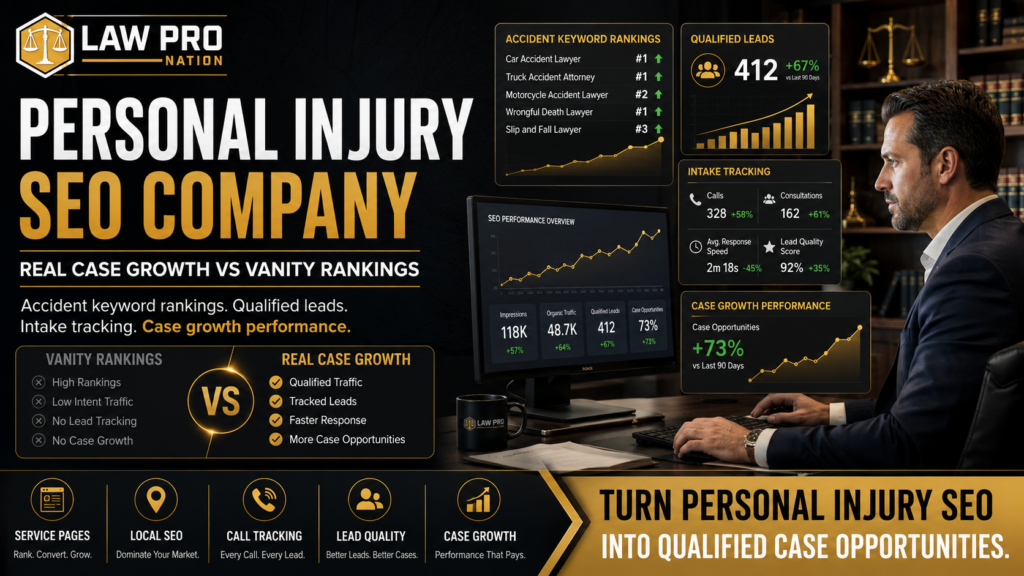
Vanity rankings may look good in a monthly report. They may show keyword movement, blog traffic, impressions, and a few page-one wins for low-value terms. But if those rankings do not produce qualified accident leads, consultation requests, and better case opportunities, they are not enough.
A serious personal injury SEO strategy should connect rankings, service pages, local visibility, content, website conversion, call tracking, and intake response. That is why strong SEO for personal injury lawyers should be judged by business outcomes, not only by search visibility.
A Personal Injury SEO Company Must Understand Case Value
Not every personal injury search has the same value. A visitor searching for “what is whiplash” may be early in the research process. A visitor searching for “car accident lawyer near me” may be ready to call. Someone searching for “truck accident attorney” may represent a very different case value than someone asking a general question about minor property damage.
A strong personal injury SEO company understands this difference. It does not chase every keyword with search volume. It maps keywords based on intent, case type, location, urgency, and likelihood of conversion.
This matters because personal injury firms do not need broad traffic. They need visibility for the types of cases they actually want. Car accidents, truck accidents, motorcycle crashes, pedestrian injuries, rideshare accidents, wrongful death, and catastrophic injury topics may each require different page structures and content strategies.
Service Pages Usually Matter More Than Random Blog Posts
Many SEO agencies try to grow law firms by publishing blog posts every month. Content can help, but blog volume alone will not build a strong personal injury SEO system.
Service pages are usually the most important commercial SEO assets. These pages target higher-intent searches and explain why someone should contact the firm. They should be built around specific accident types, injury concerns, local markets, and conversion paths.
A personal injury SEO company should know how to build and improve these pages. The page should have a clear headline, strong introduction, useful explanations, trust signals, FAQs, internal links, and a clear call to action.
This is where SEO and law firm website design overlap. A page can rank, but if it looks generic or does not guide the visitor toward a consultation, it may not produce the right results.
Local Search Is Critical for PI Firms
Personal injury prospects usually want help in their area. Even when they are researching general accident questions, they often move quickly toward local searches when they are ready to contact an attorney.
A strong PI SEO campaign should include local SEO, Google Business Profile optimization, reviews, local service pages, geographic content, and local internal linking. For accident-related searches, local visibility can strongly influence which firm gets the call.
The SEO company should understand how the website, Google Business Profile, reviews, and location relevance work together. It should also know how to avoid thin duplicate city pages that provide little value.
Local SEO is not just about ranking in maps. It is about helping injured prospects find, trust, and contact the firm quickly.
Content Should Support the Client Journey
Personal injury content should not be written only for search engines. It should help real people understand what to do after an accident, what questions to ask, how insurance may respond, why medical documentation matters, and when legal help may be useful.
This kind of content can attract search traffic, but it also builds trust. A potential client may read several pages before deciding whether to contact the firm. The content should make that decision easier.
Strong content should also support commercial pages through internal linking. For example, a post about accident lead quality can link to personal injury lawyer marketing. A post about motor vehicle accident searches can link to MVA leads for attorneys. A post about intake response should link to legal intake services.
This creates a connected SEO ecosystem instead of a disconnected blog archive.
The Agency Should Track More Than Rankings
Rankings matter, but they are not the final measure of SEO success. A personal injury SEO company should also track organic calls, form submissions, consultation requests, page-level conversions, local visibility, click-through rates, and lead quality.
A page that gets 1,000 visits but no qualified leads may be less valuable than a page that gets 100 visits and produces serious case inquiries.
For PI firms, lead quality is especially important. A campaign should help identify whether the inquiry involves injury, treatment, liability, geography, insurance, accident timing, and representation status. Without this feedback, the agency may continue optimizing for traffic that does not match the firm’s case goals.
That is why SEO should connect with intake and lead scoring. A strong campaign should help the firm understand not only where leads come from, but which sources produce better opportunities.
Intake Speed Can Make or Break SEO ROI
SEO can generate interest, but intake determines whether that interest becomes a consultation. Personal injury prospects often contact multiple firms. If one firm responds slowly, another firm may win the case.
A personal injury SEO company should understand this reality. It should not treat the form submission or phone call as the end of the marketing journey. It should care about what happens after the inquiry.
Strong legal intake services can help firms respond faster, qualify better, follow up consistently, and reduce missed opportunities. When SEO and intake work together, the firm gets a clearer view of which organic traffic is actually valuable.
PPC Data Can Improve SEO Strategy
SEO and paid search should not operate in separate silos. Paid campaigns can reveal which keywords, messages, locations, and landing pages produce the best leads. Those insights can help improve SEO pages.
For example, if a Google Ads campaign shows strong conversion from a specific accident-related keyword, the firm may want a stronger organic page for that same intent. If paid search data shows that certain phrases attract weak leads, the SEO strategy can avoid over-prioritizing those topics.
That is why PPC for lawyers and Google Ads for lawyers can support a stronger long-term SEO plan when tracked properly.
The goal is not to choose one channel blindly. The goal is to build a smarter acquisition system where each channel informs the others.
Watch Out for Vanity Metrics
Personal injury firms should be cautious when an SEO agency focuses too heavily on surface-level wins.
Examples of vanity metrics include rankings for low-intent keywords, traffic from irrelevant blog topics, impressions without clicks, clicks without leads, and reports that do not connect to calls or consultations.
These metrics may look impressive, but they do not necessarily mean the firm is growing.
A better SEO partner will explain which pages are producing qualified visibility, which topics support case acquisition, which rankings matter most, and which actions should improve conversion.
This is one reason many firms benefit from working with a specialized law firm marketing agency instead of a general SEO vendor. The strategy should be tied to business outcomes from the start.
What a Strong Personal Injury SEO Company Should Provide
A strong personal injury SEO company should begin with research and diagnosis. It should review the firm’s market, competitors, current rankings, website structure, local visibility, content gaps, technical SEO, Google Business Profile, reviews, landing pages, and intake flow.
It should then prioritize the highest-impact work. That may include rebuilding key service pages, improving local SEO, fixing technical issues, creating content clusters, adding internal links, improving metadata, strengthening CTAs, and connecting tracking to intake.
The agency should also explain what it is doing and why. Attorneys should not be left guessing whether the campaign is working.
The best SEO partner acts like a growth strategist, not a content vendor.
Questions to Ask Before Hiring a PI SEO Company
Before hiring a personal injury SEO company, attorneys should ask specific questions.
How do you decide which personal injury keywords matter most? Do you prioritize accident service pages or blogs first? How do you approach local SEO? How do you measure lead quality? Do you connect SEO with intake feedback? How do you track calls and forms? What technical SEO issues do you review? How do you use internal linking? How do you avoid thin or duplicated content?
The answers should be clear and practical. If the agency talks only about rankings and blog production, the strategy may be too shallow.
Final Thoughts
A personal injury SEO company should help law firms attract better case opportunities, not just more website visitors. Rankings matter, but they only matter when they support qualified traffic, trust, conversion, intake, and signed-case potential.
The strongest PI SEO strategy connects search intent, service pages, local authority, content, website design, tracking, intake, and follow-up into one growth system.
If your firm wants SEO that is built around real case growth instead of vanity metrics, LawProNation can help.
Apply for your FREE Discovery Call with LawProNation to discuss how your firm can build a stronger personal injury SEO system.
FAQs
What is a personal injury SEO company?
A personal injury SEO company helps PI law firms improve search visibility for accident, injury, and local legal searches through service pages, content, technical SEO, local SEO, and conversion strategy.
How is personal injury SEO different from general SEO?
Personal injury SEO is more competitive and case-value driven. It requires stronger keyword targeting, local SEO, trust-building content, service pages, intake tracking, and conversion-focused strategy.
Should PI firms focus on rankings or leads?
PI firms should track rankings, but they should focus on qualified leads, consultation requests, call quality, and signed-case potential. Rankings alone do not guarantee growth.
Why do personal injury SEO campaigns need service pages?
Service pages target higher-intent searches and help prospects understand why they should contact the firm. Blog posts can support SEO, but service pages usually drive more commercial value.
Can PPC help personal injury SEO?
Yes. PPC data can show which keywords, messages, and landing pages convert. Those insights can help improve SEO strategy and organic service pages.
How does intake affect personal injury SEO ROI?
Intake affects ROI because SEO traffic only becomes valuable when inquiries are answered quickly, qualified properly, and followed up with consistently.
How does LawProNation approach personal injury SEO?
LawProNation connects personal injury SEO with service pages, content strategy, local visibility, website design, PPC, intake, lead quality, and the Case Attraction System™.