
Personal injury lawyer advertising is one of the most competitive areas in legal marketing. Accident keywords are expensive, prospects often compare multiple firms, and small campaign mistakes can turn into serious wasted spend. For PI firms, the goal is not simply to buy more clicks or generate more form submissions. The goal is to attract qualified accident prospects and convert them before another firm wins the case.
Many personal injury firms struggle with advertising because their campaigns are disconnected. Ads run in one system, landing pages are built somewhere else, call tracking is incomplete, intake is slow, and reports focus on lead volume instead of lead quality. When those pieces do not work together, advertising becomes expensive fast.
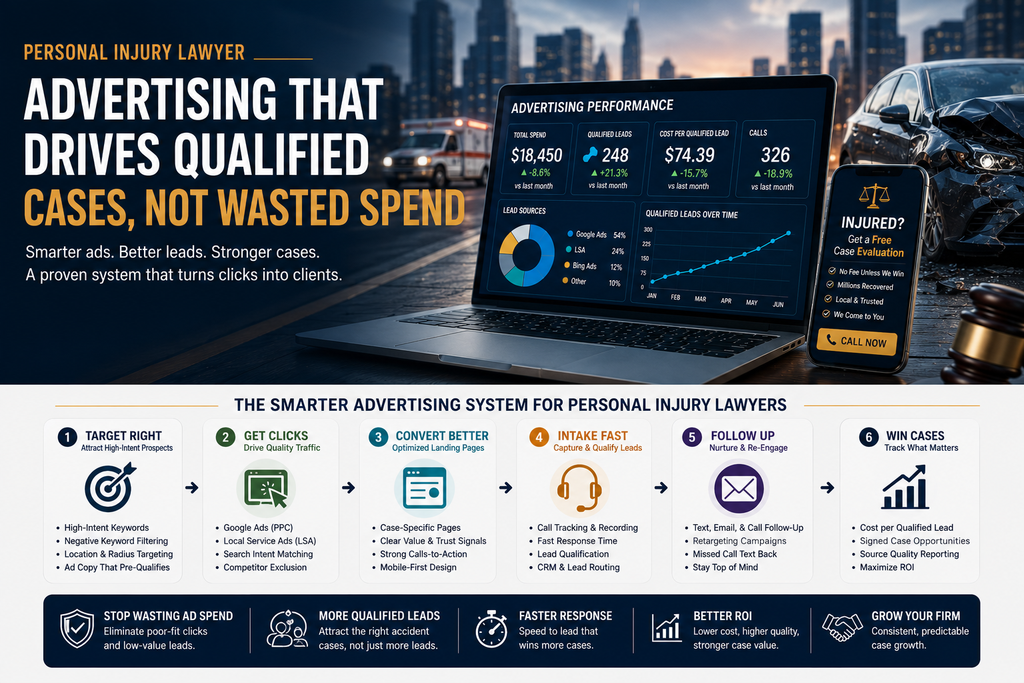
Strong personal injury lawyer marketing should connect paid traffic, landing pages, intake, tracking, follow-up, and case-quality feedback into one system. That is how firms compete without wasting budget on poor-fit inquiries.
Start With the Cases You Actually Want
Before spending money on advertising, a personal injury firm should define the types of cases it wants more of. Not every lead is equally valuable. A car accident with clear injuries may require a different strategy than a minor property-damage inquiry. A truck accident, rideshare crash, motorcycle accident, pedestrian injury, wrongful death matter, or catastrophic injury claim may each require different messaging and qualification.
If the firm does not define case quality first, advertising can easily chase volume. More leads may look good in a report, but if they are outside the service area, unrelated to injury, already represented, or too weak to pursue, they can drain intake time and budget.
A smarter advertising strategy begins by mapping ideal cases, preferred locations, intake criteria, and source quality. Once that foundation is clear, the campaign can target better opportunities instead of simply buying more traffic.
PPC Must Be Built Around Legal Intent
Paid search is often one of the most direct advertising channels for PI firms because it captures people actively searching for help. But not every search has the same intent.
A person searching “car accident lawyer near me” may be much closer to calling than someone searching “what to do after a minor fender bender.” Both searches may matter, but they should not receive the same bid strategy, landing page, or follow-up path.
Strong PPC for lawyers should separate high-intent hiring searches from research searches, competitor searches, broad informational queries, and irrelevant traffic. Campaigns should use tight keyword groups, negative keywords, location targeting, call tracking, and landing pages that match the exact case type.
The purpose of PPC is not to buy visibility at any cost. The purpose is to capture qualified legal demand efficiently.
Google Ads Should Not Send Traffic to Generic Pages
One of the most expensive mistakes in personal injury lawyer advertising is sending paid traffic to the homepage or a generic practice page. If someone clicks an ad about a car accident lawyer, they should land on a page that speaks directly to accident victims.
Strong Google Ads for lawyers should connect the keyword, ad copy, landing page, CTA, tracking, and intake process. The message should feel consistent from the search result to the page to the first intake conversation.
A focused landing page should explain who the firm helps, what types of cases it handles, why fast action matters, how the consultation process works, and what the visitor should do next. It should also make calling or submitting a form simple on mobile.
When paid traffic lands on a page that matches intent, the firm has a better chance of converting the click into a qualified inquiry.
Landing Pages Should Filter and Convert
A PI landing page should do two things at once. It should convert serious prospects, and it should help filter poor-fit inquiries.
That does not mean making the page cold or difficult to use. It means the page should clearly describe the types of cases the firm handles, the locations it serves, the injuries or accident types it focuses on, and the next step for a potential client.
Strong law firm website design can improve advertising performance because design affects trust, clarity, speed, mobile usability, and conversion. A page can receive expensive paid traffic and still underperform if the design is confusing, slow, or generic.
For personal injury advertising, landing pages should include clear headlines, strong CTAs, trust signals, short forms, phone visibility, FAQs, and tracking. The visitor should not have to search for the next step.
Local Service Ads Can Help, But They Still Need Intake
Local Service Ads can be useful for law firms because they appear prominently and can generate phone-based leads. However, they are not a complete strategy by themselves.
PI firms still need to evaluate lead quality, call handling, review strength, geographic targeting, and response speed. If the firm misses calls or fails to qualify prospects quickly, the campaign can still waste money.
Local Service Ads also depend heavily on trust. Reviews, responsiveness, profile completeness, and clear service alignment can influence how prospects compare firms.
The key is to treat LSAs as part of the advertising system, not as a standalone shortcut.
MVA Lead Campaigns Need Strict Qualification
Motor vehicle accident leads can be valuable, but they can also vary widely in quality. Some leads may involve no injury, no treatment, weak liability, poor location fit, or a person who is already represented.
That is why MVA leads for attorneys should be tracked carefully. A firm should know which campaigns, keywords, locations, and landing pages produce serious accident inquiries.
Better MVA advertising includes source tracking, lead scoring, intake questions, follow-up workflows, and reporting that separates raw lead volume from qualified opportunities.
The best campaigns are not the ones that produce the most forms. They are the ones that produce the right accident prospects at a sustainable cost.
Personal Injury Leads Should Be Judged by Source Quality
Many PI firms invest in a mix of paid search, LSAs, SEO, referral campaigns, third-party vendors, retargeting, and social ads. Without source tracking, it becomes difficult to know where the best leads are coming from.
Strong personal injury leads strategy should evaluate each source by qualification rate, response speed, consultation rate, signed-case potential, and cost per qualified opportunity.
A source that produces fewer leads but better conversations may be more valuable than a source that fills the CRM with weak inquiries. This is especially important when attorney time and intake resources are limited.
Advertising decisions should be based on source quality, not vanity lead count.
Intake Speed Reduces Wasted Ad Spend
Personal injury prospects often contact more than one firm. If your firm pays for the click but responds slowly, another firm may sign the case.
This is why legal intake services matter so much in PI advertising. Intake is not separate from marketing. It is where marketing either turns into an opportunity or becomes wasted spend.
A strong intake process should include fast response, call tracking, lead source visibility, form routing, qualification questions, CRM updates, consultation booking, and follow-up reminders.
If the firm cannot answer calls quickly or follow up consistently, increasing the ad budget may only increase wasted opportunities.
Negative Keywords Protect the Budget
Negative keywords are one of the most important tools in paid search advertising. They help prevent ads from showing for irrelevant searches.
For PI campaigns, negative keywords may help filter searches related to jobs, salaries, templates, insurance careers, legal definitions with no hiring intent, free non-attorney resources, or unrelated practice areas. The exact list should be based on campaign data, search term reports, and lead quality feedback.
Negative keyword work should be ongoing. Search behavior changes, and poor-fit terms can appear over time. Reviewing search terms regularly helps reduce wasted clicks and improve campaign efficiency.
Ad Copy Should Pre-Qualify Prospects
Ad copy should do more than attract clicks. It should attract the right clicks.
For personal injury lawyer advertising, ad copy should clearly communicate the case type, location, consultation offer, and reason to contact the firm. It should also avoid being so broad that it attracts irrelevant inquiries.
A car accident campaign should speak directly to car accident prospects. A truck accident campaign should speak to truck accident concerns. A wrongful death campaign should use appropriate sensitivity and trust-building language.
The goal is to align the ad with the prospect’s actual situation so the click is more likely to become a qualified inquiry.
Retargeting Can Recover Undecided Prospects
Not every injured prospect contacts a firm on the first visit. Some people compare multiple attorneys. Some are not ready to call. Some leave the site and return later. Retargeting can help keep the firm visible during that decision period.
Retargeting should be used carefully and professionally. The message should build trust, reinforce the consultation offer, and guide visitors back to helpful pages.
For PI firms, retargeting can support paid search and SEO by giving undecided prospects another reason to return. It should not replace strong landing pages or intake, but it can help reduce lost opportunities.
SEO Can Lower Long-Term Dependence on Paid Ads
Advertising can generate faster visibility, but relying only on paid traffic can make growth expensive. SEO can help build a longer-term organic foundation.
Strong SEO for personal injury lawyers can support advertising by improving service pages, content authority, local visibility, and trust. PPC data can also reveal which keywords deserve stronger organic pages.
When SEO and advertising work together, the firm can use paid search to capture immediate demand while building organic assets that may reduce dependence on paid clicks over time.
The strongest PI firms usually do not choose between SEO and ads. They use both strategically.
Reporting Should Focus on Cost Per Qualified Lead
A personal injury advertising report should not stop at clicks, impressions, CTR, or raw cost per lead. Those numbers matter, but they do not show the full picture.
A more useful report should show calls, forms, qualified leads, consultation requests, cost per qualified lead, landing page conversion, lead source quality, response time, and intake outcome when available.
The firm should know which campaigns are producing real opportunities and which campaigns are only creating activity.
This is where a specialized law firm marketing agency can help. The agency should connect paid performance with intake feedback so the firm can make better budget decisions.
Common Advertising Mistakes PI Firms Should Avoid
One common mistake is bidding on broad keywords without enough filtering. Broad terms can quickly attract poor-fit clicks.
Another mistake is using one landing page for every campaign. Different accident types and search intents need different pages.
A third mistake is failing to track calls properly. If the firm cannot connect calls to campaigns, it cannot know what is working.
A fourth mistake is judging success by lead volume alone. Lead quality matters more than raw count.
A fifth mistake is ignoring intake response. Slow follow-up can waste expensive leads.
A sixth mistake is separating PPC from SEO, content, and website strategy. Paid data should inform the broader marketing system.
Build an Advertising System, Not Just Campaigns
Personal injury lawyer advertising works best when every part of the system is connected.
Keywords attract intent. Ads earn the click. Landing pages build trust. Forms and calls create inquiries. Intake qualifies the prospect. Follow-up keeps the opportunity alive. Reporting identifies what to scale and what to cut.
When these pieces work together, the firm can compete more intelligently. When they are disconnected, ad spend becomes harder to control.
Final Thoughts
Personal injury lawyer advertising can be powerful, but it must be managed with discipline. PI firms need campaigns that target the right searches, send traffic to focused landing pages, track lead source quality, connect with intake, and measure results by qualified opportunities.
The firms that compete most effectively are not always the firms with the biggest budgets. They are often the firms with the clearest targeting, strongest conversion paths, fastest intake, and best understanding of lead quality.
If your firm wants a smarter advertising system built around qualified accident cases, Apply for your FREE Discovery Call with LawProNation.
FAQs
What is personal injury lawyer advertising?
Personal injury lawyer advertising is the use of paid campaigns, search ads, Local Service Ads, landing pages, retargeting, and lead generation systems to attract potential injury clients.
Why is personal injury advertising expensive?
Personal injury advertising is expensive because accident-related keywords are highly competitive, many firms are bidding for the same prospects, and strong cases can be valuable.
How can PI firms reduce wasted ad spend?
PI firms can reduce wasted spend by targeting high-intent keywords, using negative keywords, improving landing pages, tracking calls and forms, reviewing lead quality, and strengthening intake response.
Should personal injury lawyers use Google Ads?
Google Ads can work for personal injury lawyers when campaigns are built around legal intent, strong landing pages, call tracking, intake feedback, and qualified lead measurement.
Are more personal injury leads always better?
No. More leads are only useful if they are qualified, relevant, timely, and aligned with the firm’s case goals, practice areas, and target locations.
How does intake affect advertising ROI?
Intake affects ROI because paid leads only become valuable when calls are answered quickly, forms are followed up with, and prospects are qualified properly.
How does LawProNation help with PI advertising?
LawProNation connects PPC, Google Ads, landing pages, MVA lead strategy, intake, tracking, follow-up, and lead quality into a Case Attraction System™ for personal injury firms.