
Personal injury landing pages have one job: turn accident traffic into qualified inquiries. A personal injury firm can spend heavily on SEO, Google Ads, Local Service Ads, social campaigns, or third-party leads, but if the landing page does not build trust quickly and make action easy, valuable prospects can leave without contacting the firm.
Accident prospects are not casually browsing. Many are dealing with pain, vehicle damage, medical appointments, missed work, insurance pressure, and uncertainty about what to do next. They may be comparing several attorneys within a short period of time.
That is why strong personal injury lawyer marketing needs landing pages that match the prospect’s urgency, answer the right questions, reduce friction, and connect directly to intake. A landing page should not just look good. It should help the firm convert the right accident leads before competitors do.
Personal Injury Landing Pages Need a Clear Case Focus
A generic personal injury page is usually not enough for high-intent accident traffic. A person searching for help after a car accident has different concerns than someone searching for a truck accident lawyer, motorcycle crash attorney, pedestrian accident lawyer, or wrongful death attorney.
Each major case type should have its own message, structure, and conversion path when the firm is actively targeting that category. The page should make the visitor feel like they are in the right place immediately.
A car accident landing page should speak directly to drivers, passengers, injuries, insurance claims, medical bills, vehicle damage, and next steps. A truck accident landing page should address commercial vehicles, trucking companies, serious injuries, evidence preservation, and urgency. A rideshare accident page should explain Uber, Lyft, passenger, driver, and insurance confusion.
The more specific the page is, the easier it becomes to match search intent and improve conversion quality.
The Headline Should Match the Accident Search
The headline is one of the most important conversion elements on a personal injury landing page. It should confirm the visitor’s problem quickly.
A weak headline says something broad like “Need Legal Help?” or “Experienced Attorneys You Can Trust.” Those lines may sound professional, but they do not strongly match accident intent.
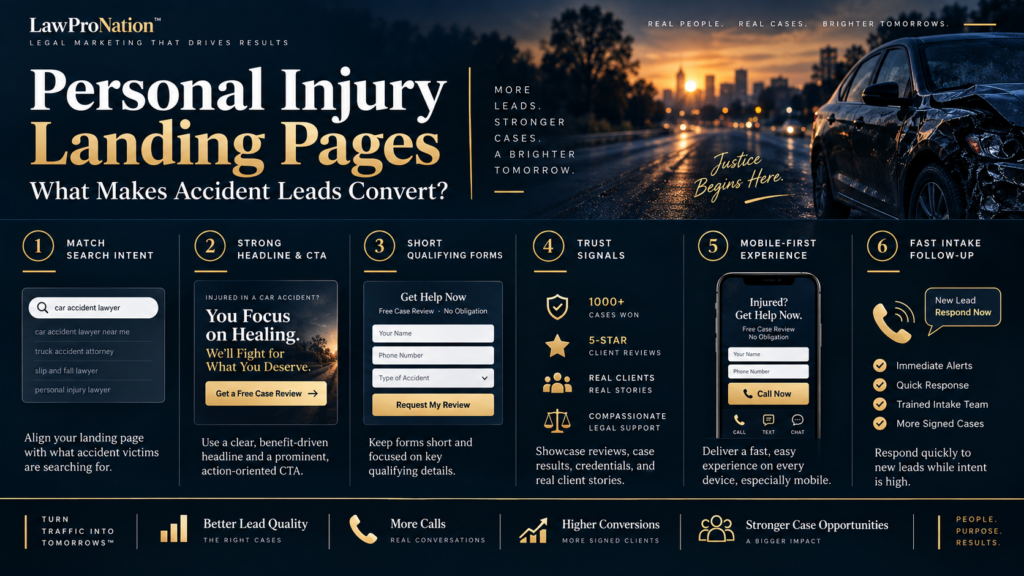
A stronger headline speaks directly to the case type and next step. Examples include “Injured in a Car Accident? Get a Free Case Evaluation” or “Truck Accident Lawyer for Serious Injury Claims.”
For firms investing in MVA leads for attorneys, the headline should align with the traffic source. If the ad, keyword, or campaign is about motor vehicle accidents, the page should not feel like a general law firm brochure.
The First Screen Should Build Trust Fast
Most visitors decide quickly whether to stay on a page. The first screen should clearly show who the page is for, what problem it solves, why the firm is credible, and what the visitor should do next.
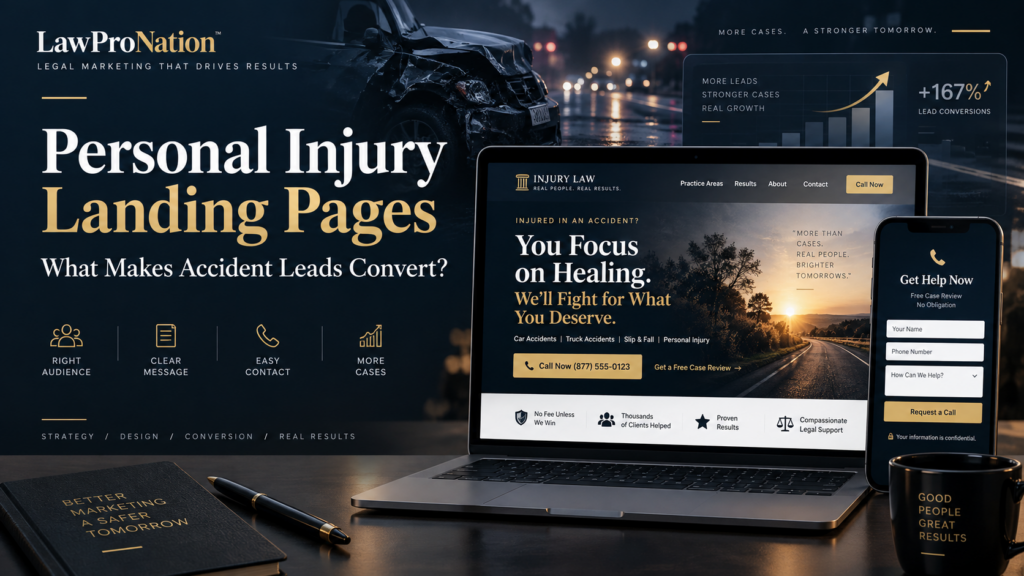
A strong first screen may include a direct headline, short supporting statement, clear CTA, visible phone number, short form, trust signals, and reassurance that the consultation or case evaluation is simple.
The page should not begin with a long history of the firm. Accident prospects need clarity before background. They want to know whether the firm handles their type of case, whether help is available, and whether the next step is easy.
Strong law firm website design supports this by making the hero section simple, fast, mobile-friendly, and conversion-focused.
The CTA Should Be Specific
The call to action should not be vague. “Submit” is weak. “Contact Us” is better, but still generic. A stronger CTA tells the visitor exactly what action they are taking.
For personal injury landing pages, CTA options may include “Get a Free Case Evaluation,” “Request Your Free Consultation,” “Speak With an Intake Specialist,” or “See If You Have a Case.”
The CTA should appear near the top of the page, after important trust sections, and again near the end. On mobile, the phone CTA should be easy to tap.
For LawProNation’s own attorney-facing content, the CTA should remain Apply for your FREE Discovery Call, but consumer-facing PI pages should usually use a case-evaluation or consultation-based CTA.
Forms Should Balance Conversion and Lead Quality
A personal injury form should be simple enough to complete quickly but useful enough to qualify the lead. If the form is too long, visitors may abandon it. If the form is too vague, intake may not have enough information to prioritize the inquiry.
A practical PI landing page form may ask for name, phone number, email, accident type, accident date, injury status, location, and a short description of what happened. The exact form should depend on the campaign and firm’s intake process.
For paid traffic, every form field matters. A short form may generate more submissions, but a slightly more specific form can improve lead quality. The right balance depends on the firm’s goals, lead volume, and intake capacity.
A strong personal injury leads strategy should connect form design with qualification, source tracking, and follow-up.
Phone Calls Must Be Easy
Many accident prospects prefer to call rather than fill out a form. The phone number should be visible, tappable on mobile, and tracked by source.
A landing page should not hide the phone number in the footer. It should be easy to find near the top and repeated where appropriate. Mobile visitors should be able to tap once and call.
However, phone visibility only helps if intake is ready. If calls are missed, sent to voicemail, routed poorly, or answered without a clear qualification process, the landing page’s conversion potential is wasted.
That is why legal intake services should be part of the landing page strategy. The page generates the inquiry, but intake determines whether that inquiry becomes a qualified consultation.
Trust Signals Should Feel Relevant
Trust is critical in personal injury marketing. Prospects are making a serious decision, often during a stressful time. They need reassurance that the firm is credible, responsive, and capable of helping with their type of case.
Trust signals may include reviews, testimonials, case results where appropriate, attorney credentials, years of experience, local presence, media mentions, awards, professional memberships, secure form messaging, and clear process explanations.
The best trust signals are specific. A generic badge is less persuasive than a testimonial from an accident client, a clear explanation of the firm’s process, or a strong review pattern related to communication and results.
Trust signals should appear early and throughout the page. Do not make visitors scroll to the bottom to find proof.
The Page Should Address Accident-Specific Concerns
A strong personal injury landing page should answer the questions accident prospects are already thinking about.
They may wonder whether they have a case, who pays medical bills, whether they should talk to the insurance company, how much the case may be worth, what happens if they were partly at fault, whether they need medical treatment, or how long they have to act.
The page does not need to answer every legal question in detail, but it should show that the firm understands the situation. Short sections and FAQs can reduce anxiety and help the visitor feel more confident about reaching out.
This is especially important for SEO for personal injury lawyers, because useful accident-focused content can support both rankings and conversion.
Landing Pages Should Match the Traffic Source
A landing page should match where the visitor came from. Google Ads traffic, organic SEO traffic, retargeting traffic, Local Service Ads callers, and social media visitors may all need slightly different messaging.
High-intent Google Ads traffic may need a direct conversion page with a strong CTA and short form. Organic traffic may need more explanation, FAQs, internal links, and helpful context. Retargeting traffic may need stronger reassurance, proof, and objection handling.
Strong Google Ads for lawyers should connect the search term, ad copy, landing page, call tracking, form tracking, and intake workflow. If the ad promises accident help but the page feels generic, conversion usually suffers.
Mobile Experience Is Non-Negotiable
Many accident prospects search from a phone. The landing page must be built for mobile first.
A strong mobile page should load quickly, use clear headings, make the phone number tappable, keep the form easy to complete, avoid crowded sections, and place CTAs where visitors can reach them comfortably.
Images should support the message without slowing the page. Large blocks of text should be broken into short paragraphs. Trust signals should be visible without excessive scrolling.
A page that looks impressive on desktop but feels difficult on mobile can lose qualified accident leads.
Speed Matters
Slow landing pages can damage conversion. Accident prospects may already be stressed or distracted. If a page takes too long to load, they may leave and contact another firm.
Speed matters even more for paid traffic because every lost visitor may represent wasted ad spend. Compress images, avoid unnecessary scripts, reduce bloated design elements, and test mobile performance regularly.
Landing page design should look professional, but it should not sacrifice usability. A clean, fast page often converts better than a visually heavy page with too many animations, videos, or oversized graphics.
The Page Should Filter Poor-Fit Inquiries
A landing page should not only increase leads. It should help attract better leads.
This does not mean discouraging people who need help. It means clearly explaining the types of accident cases the firm handles, the locations it serves, and the next step for qualified prospects.
For example, a PI firm may want the page to focus on injury-related crashes, not minor property damage only. It may want to mention service areas, accident types, and the importance of medical treatment or documentation.
Better filtering helps intake spend more time with serious prospects and less time sorting through poor-fit inquiries.
Intake Follow-Up Should Be Immediate
A form submission should never sit unanswered. Accident prospects may contact multiple firms. If your firm waits too long, the opportunity may be lost.
A strong landing page should connect directly to intake workflows. That may include instant email confirmations, SMS follow-up, CRM routing, call alerts, intake team notifications, and scheduled follow-up tasks.
For personal injury landing pages, speed-to-lead is part of conversion. The faster the firm responds, the better chance it has to engage the prospect while the need is still urgent.
The strongest landing page cannot fix a slow follow-up process.
Tracking Should Connect Leads to Sources
Personal injury landing pages should be tracked carefully. The firm should know which source produced the inquiry, which campaign generated the call, which page converted, and whether the lead was qualified.
Important tracking may include form submissions, phone calls, click-to-call actions, landing page conversion rate, campaign source, keyword source, cost per lead, cost per qualified lead, consultation requests, and intake outcomes.
This is especially important for firms investing in PPC for lawyers. PPC should not be judged only by clicks or raw leads. It should be judged by qualified opportunities and cost per qualified lead.
Use Retargeting for Visitors Who Do Not Convert
Not every accident prospect contacts a firm on the first visit. Some compare attorneys, talk to family, continue researching, or wait until symptoms develop.
Retargeting can help bring those visitors back. A retargeting ad can remind them about a free case evaluation, send them to a helpful resource, or reinforce the firm’s trust signals.
Retargeting should be professional and respectful. Personal injury messaging should avoid sounding aggressive or insensitive. The goal is to stay visible and helpful while the prospect decides what to do next.
Common PI Landing Page Mistakes
One common mistake is sending every campaign to the homepage. A homepage is usually too broad for accident-specific traffic.
Another mistake is using one page for every case type. Car accident, truck accident, motorcycle accident, and wrongful death prospects may need different messaging.
A third mistake is hiding the CTA or using vague button text.
A fourth mistake is asking too many form questions too early.
A fifth mistake is ignoring mobile speed and usability.
A sixth mistake is tracking only form submissions instead of qualified leads.
A seventh mistake is building landing pages without connecting them to intake.
What a Strong Personal Injury Landing Page Should Include
A strong PI landing page should include a case-specific headline, clear opening statement, visible phone number, focused CTA, short form, trust signals, accident-specific content, FAQs, mobile-first layout, fast load speed, call tracking, form tracking, and immediate intake follow-up.
It should also make the visitor feel understood. The page should speak to the accident, the stress, the uncertainty, and the need for a clear next step.
The best landing pages do not simply ask for a lead. They help the prospect feel confident enough to start the conversation.
Final Thoughts
Personal injury landing pages are critical conversion assets. They turn accident traffic from SEO, PPC, Google Ads, LSAs, retargeting, referrals, and lead campaigns into real inquiries.
The strongest pages are specific, fast, trustworthy, mobile-friendly, and connected to intake. They match the accident type, explain the next step, reduce friction, track performance, and help the firm focus on qualified opportunities.
If your firm wants landing pages built around accident lead quality and case growth, Apply for your FREE Discovery Call with LawProNation.
FAQs
What is a personal injury landing page?
A personal injury landing page is a focused web page built to convert accident-related traffic into calls, form submissions, free case evaluations, consultation requests, or qualified leads.
Why do personal injury lawyers need landing pages?
Personal injury lawyers need landing pages because accident prospects often have urgent, specific concerns. A focused page can match their search intent better than a generic homepage.
What should be included on a PI landing page?
A strong PI landing page should include a case-specific headline, clear CTA, visible phone number, short form, trust signals, FAQs, mobile-friendly design, tracking, and intake follow-up.
Should accident traffic go to the homepage?
Usually no. Accident traffic should usually go to a focused landing page that matches the case type, location, search intent, and call to action.
How do landing pages improve personal injury lead quality?
Landing pages improve lead quality by matching the prospect’s accident type, filtering poor-fit inquiries, collecting useful details, and connecting the lead source to intake feedback.
Why does intake matter for personal injury landing pages?
Intake matters because a landing page only creates the inquiry. The firm must respond quickly, qualify the lead properly, and follow up consistently to convert the opportunity.
How does LawProNation build personal injury landing pages?
LawProNation builds personal injury landing pages around case intent, SEO, PPC, Google Ads, MVA lead strategy, website conversion, tracking, intake feedback, and qualified lead generation.