
Personal injury attorney ads can create fast visibility, but they can also become expensive when the firm does not understand which platform is best for each stage of the client journey. Google Ads, Local Service Ads, Facebook, Instagram, and retargeting can all help PI firms generate attention, but they do not work the same way.
Some channels capture people who are actively searching for a lawyer right now. Other channels create awareness, build trust, or bring undecided visitors back after they leave the website. The mistake many firms make is expecting every platform to produce the same type of lead.
A stronger advertising strategy starts by matching the channel to the prospect’s intent. High-intent search traffic needs focused landing pages and fast intake. Social traffic may need education and follow-up. Retargeting needs trust-building and repetition. Strong personal injury lawyer marketing connects these channels into one full-funnel system instead of treating each campaign separately.
Why PI Advertising Needs Channel Clarity
Personal injury law is highly competitive because accident-related leads can be valuable. Many firms are bidding for the same prospects, especially in major metro areas and high-value case categories like car accidents, truck accidents, motorcycle crashes, rideshare collisions, catastrophic injuries, and wrongful death matters.
When ad spend is high, strategy matters. A campaign that generates clicks is not enough. A campaign that generates calls is not enough either if those calls are low quality, poorly tracked, or not handled quickly.
Personal injury attorney ads should be evaluated by qualified opportunities, not surface-level activity. That means the firm needs to compare each channel based on search intent, lead quality, speed, cost, landing page fit, intake requirements, and follow-up needs.
Google Ads: Best for High-Intent Search Demand
Google Ads is often the most direct channel for personal injury advertising because it reaches people who are actively searching. Someone typing “car accident lawyer near me” or “personal injury attorney free consultation” is usually closer to taking action than someone passively scrolling on social media.
That makes Google Ads powerful, but also expensive. If the campaign targets broad keywords without strong filtering, the firm may pay for clicks from people who are not injured, outside the service area, already represented, or not ready to hire.
Strong Google Ads for lawyers should include high-intent keyword targeting, negative keywords, location controls, call tracking, form tracking, ad copy testing, conversion tracking, and landing pages that match the exact search.
Google Ads is usually best for capturing active demand. It is not always best for educating cold audiences or building long-term brand authority by itself.
When Google Ads Works Best for PI Firms
Google Ads works best when the firm has a clear practice-area focus, strong landing pages, fast intake, and enough budget to compete in the market.
It can be especially useful for accident-specific campaigns such as car accident lawyer, truck accident attorney, motorcycle accident lawyer, pedestrian accident attorney, or rideshare accident lawyer. Each campaign should have its own keyword group, ad copy, landing page, and tracking.
The goal is not to send every click to the homepage. A person searching for a car accident lawyer should land on a car accident page. A person searching for a truck accident attorney should land on a truck accident page. Intent match improves trust and can improve conversion.
For firms that want better campaign structure, PPC for lawyers should be built around case intent, not generic traffic.
Google Ads Weaknesses
Google Ads can waste money quickly when campaigns are too broad. Broad match keywords, weak negative keyword lists, generic landing pages, poor tracking, and slow intake can all hurt performance.
Another weakness is competition. Personal injury keywords can attract aggressive bidding. If a firm does not track qualified leads, it may think a campaign is working because calls are coming in, even though those calls are not turning into viable cases.
Google Ads also requires active management. Search terms, bids, ad copy, landing pages, conversion data, and intake feedback should be reviewed consistently.
Local Service Ads: Best for Phone-Based Local Leads
Local Service Ads can be useful for personal injury attorneys because they appear prominently in local search and are built around direct lead generation. For many users, LSAs feel simple: they search, compare attorneys, check reviews, and call.
LSAs can work well when the firm has strong reviews, a complete profile, a clear service area, and fast call response. They are especially useful for local, urgent searches where the prospect wants to speak with someone quickly.
However, LSAs are not magic. They still require review strength, profile quality, lead quality evaluation, and intake discipline. A firm can receive calls from LSAs and still waste opportunities if the phone is not answered quickly or if qualification is weak.
For PI firms, LSAs should be treated as one part of the broader personal injury leads strategy, not as the entire lead system.
When LSAs Work Best
LSAs work best when prospects are searching locally and are ready to contact a firm quickly. They can be helpful for firms with strong local credibility and a responsive intake team.
The channel is especially valuable when the firm can answer calls fast, document lead quality, and identify which calls deserve immediate follow-up. If the firm misses calls or fails to respond quickly, LSA performance may suffer.
LSAs can also support brand trust because reviews and profile presentation matter. A prospect comparing several firms may choose the one that appears more credible, responsive, and locally relevant.
LSA Weaknesses
The biggest weakness of LSAs is limited control compared with full Google Ads campaigns. The firm may have less flexibility around keywords, landing pages, ad copy, and funnel design.
Another weakness is call quality variation. Not every LSA call will be a strong case. Some callers may ask general questions, have weak claims, fall outside the service area, or be looking for help the firm does not provide.
That is why LSAs need strong intake tracking. A firm should measure not only lead count, but also qualified lead rate, consultation rate, and signed-case potential.
Facebook and Instagram Ads: Best for Awareness and Retargeting
Facebook and Instagram ads work differently from search ads. Most users on Meta platforms are not actively searching for a personal injury attorney at that moment. They are scrolling through content, watching videos, checking updates, or browsing casually.
That means Meta ads are usually weaker for immediate high-intent demand capture but useful for awareness, education, retargeting, and audience nurturing.
A personal injury firm may use Facebook and Instagram to promote educational content, accident checklists, free case evaluation messaging, client-focused videos, or retargeting ads for people who already visited the website.
Meta ads can support MVA leads for attorneys when the strategy is careful, but firms should not expect cold social traffic to behave exactly like Google search traffic.
When Facebook and Instagram Ads Work Best
Facebook and Instagram ads can work well when the firm has strong creative, clear messaging, and a follow-up system. They are often useful for retargeting website visitors, re-engaging people who interacted with content, or educating potential clients who may not be ready to call immediately.
For example, someone who recently visited a car accident landing page but did not submit a form may later see an ad reminding them about a free case evaluation. Someone who watched a short video about insurance mistakes after a crash may later receive a retargeting ad with a stronger consultation CTA.
These channels are also useful for brand visibility. If a firm wants to stay top of mind in a competitive market, social advertising can support the broader funnel.
Facebook and Instagram Weaknesses
The main weakness is intent. Most users are not actively searching for legal help at the moment they see the ad. That means conversion rates may be lower than high-intent search traffic.
Another weakness is lead quality. Social leads can be more casual, less urgent, or less qualified if the campaign uses broad targeting and weak forms.
To improve performance, firms need strong creative, careful audience selection, clear qualification, and follow-up workflows. Social ads should not be judged only by cheap lead cost. A low-cost lead that does not become a serious consultation is not a win.
Retargeting: Best for Bringing Back Undecided Prospects
Retargeting is one of the most important advertising layers for personal injury firms because many prospects do not convert on the first visit. They may compare several firms, talk to family, continue medical treatment, or delay action because they are overwhelmed.
Retargeting helps bring those visitors back. It can show ads to people who visited a landing page, read an article, clicked an ad, watched a video, or started but did not complete a form.
The message should be professional and trust-focused. For PI firms, retargeting can reinforce free case evaluation offers, explain the next step, highlight responsiveness, or send visitors back to a relevant accident page.
Retargeting works best when connected to strong law firm website design because the visitor must return to a page that builds trust and makes action easy.
When Retargeting Works Best
Retargeting works best when the firm already has traffic from SEO, Google Ads, LSAs, social media, referrals, or content. It is a follow-up layer, not a replacement for demand generation.
It can be especially useful for expensive traffic. If the firm paid for a click and the person did not convert, retargeting gives the firm another chance to stay visible.
Retargeting can also support long decision cycles. Not every accident prospect is ready to contact an attorney the first time they visit. A consistent but respectful retargeting campaign can keep the firm in the conversation.
Retargeting Weaknesses
Retargeting will not fix a weak offer, bad landing page, or poor intake process. It can bring people back, but the page still has to convert.
Another issue is audience size. Smaller firms with low website traffic may not have enough retargeting volume at first. In that case, SEO, paid search, and content may need to build traffic before retargeting becomes meaningful.
Retargeting also requires careful messaging. Ads should be helpful and professional, not aggressive or insensitive.
Landing Pages Matter Across Every Channel
No matter which ad platform a personal injury firm uses, landing pages matter. Sending paid traffic to a weak page is one of the fastest ways to waste budget.
A strong landing page should match the campaign. Google Ads traffic should land on a page that matches the search term. LSA callers should find a website that supports the same credibility shown in the profile. Facebook and Instagram visitors should land on a page that builds trust quickly. Retargeting visitors should return to a page that answers objections and makes the next step clear.
Strong law firm website design should support advertising by improving clarity, speed, mobile usability, trust signals, forms, phone visibility, and calls to action.
The page should not simply look good. It should help convert the right visitors into qualified inquiries.
Intake Is the Hidden Difference Between Good and Bad Ad ROI
Advertising performance is not only determined by the platform. It is also determined by what happens after the lead arrives.
If the firm misses calls, responds slowly, asks poor qualification questions, fails to follow up, or does not track source quality, the campaign may appear weaker than it really is. In many firms, the problem is not always the ad. Sometimes the problem is intake.
Strong legal intake services help turn paid traffic into real opportunities. Intake should track source, campaign, case type, injury signals, location, timing, representation status, and follow-up status.
For personal injury attorney ads, speed-to-lead matters. Prospects often contact multiple firms. The firm that responds first and communicates clearly often has an advantage.
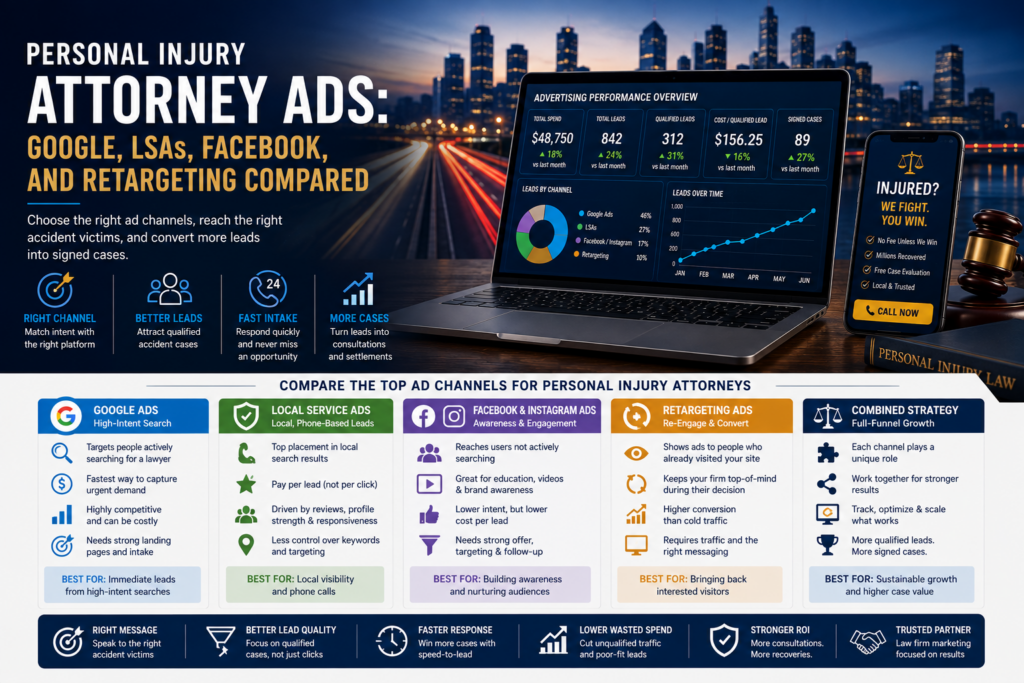
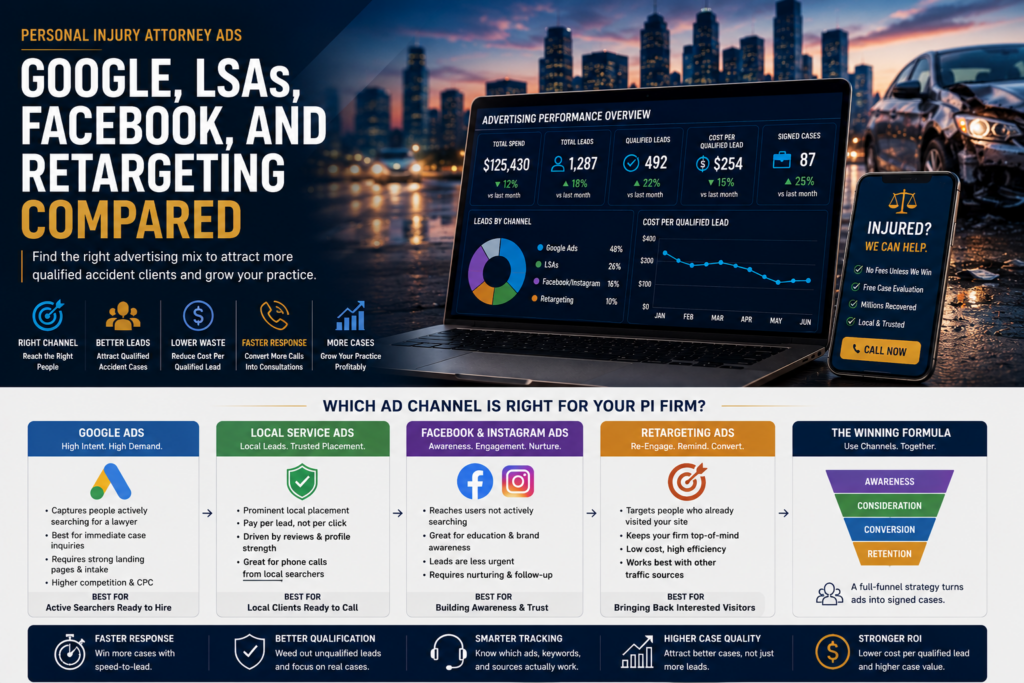
How to Compare the Main Ad Channels
Google Ads is usually strongest for active search intent. It can produce high-quality inquiries, but it may be expensive and requires tight campaign management.
Local Service Ads are useful for local phone-based leads and trust-driven comparisons. They can produce direct inquiries, but control is limited and intake quality matters heavily.
Facebook and Instagram are better for awareness, education, and retargeting than immediate high-intent demand capture. They can support the funnel, but lead quality must be monitored carefully.
Retargeting is best for re-engaging people who already showed interest. It can improve conversion efficiency, but it needs existing traffic and strong landing pages.
A smart PI advertising strategy may use all of these channels, but not for the same purpose.
SEO Should Still Support the Advertising Funnel
Paid ads can create faster visibility, but a PI firm should not ignore organic search. SEO builds long-term visibility, improves trust, and supports better landing page performance.
Strong SEO for personal injury lawyers can help the firm build accident-related service pages, educational content, local authority, internal links, and search visibility that lasts beyond paid campaigns.
SEO can also improve advertising strategy. If PPC data shows that certain keywords convert well, those topics may deserve stronger organic pages. If organic pages produce qualified calls, those same topics may deserve paid support.
The strongest growth systems use SEO and ads together.
What PI Firms Should Track
Personal injury firms should track more than ad spend and lead count. Important metrics include cost per qualified lead, cost per consultation request, landing page conversion rate, call answer rate, response time, lead source, case type, location, injury status, representation status, and signed-case potential.
This is where a specialized law firm marketing agency can help. The agency should connect campaign data with intake feedback so the firm can make better decisions.
Without quality tracking, the firm may scale the wrong channel or cut the wrong campaign.
Common PI Ad Mistakes
One common mistake is using the same landing page for every channel. Search traffic, social traffic, and retargeting traffic often need different messaging.
Another mistake is judging platforms only by lead cost. Cheap leads can be expensive if they waste intake time and do not become cases.
A third mistake is running Google Ads without negative keywords. This can attract irrelevant searches and waste budget.
A fourth mistake is expecting Facebook cold traffic to convert like Google search traffic. Social ads usually need a different funnel.
A fifth mistake is ignoring follow-up. Many prospects need multiple touches before they choose a firm.
A sixth mistake is separating ads from intake. Advertising cannot be properly judged without knowing what happened to the lead.
Final Thoughts
Personal injury attorney ads work best when each platform has a clear role. Google Ads captures high-intent search demand. Local Service Ads support direct local calls. Facebook and Instagram build awareness and support retargeting. Retargeting brings back undecided visitors. Landing pages convert interest into action. Intake determines whether the opportunity is handled properly.
The right strategy is not about choosing the trendiest platform. It is about building a connected advertising system that attracts qualified prospects, reduces wasted spend, improves response speed, and helps the firm identify which sources produce better case opportunities.
If your firm wants a smarter PI advertising system built around qualified leads instead of disconnected campaigns, Apply for your FREE Discovery Call with LawProNation.
FAQs
What are personal injury attorney ads?
Personal injury attorney ads are paid marketing campaigns used to attract potential injury clients through channels such as Google Ads, Local Service Ads, Facebook, Instagram, retargeting, and landing pages.
Are Google Ads good for personal injury lawyers?
Google Ads can work well for personal injury lawyers because they capture people actively searching for legal help. Performance depends on keyword targeting, landing pages, tracking, budget control, and intake response.
Are Local Service Ads useful for PI firms?
Local Service Ads can be useful for PI firms because they can generate direct local calls. However, firms still need strong reviews, fast call response, and lead quality tracking.
Do Facebook ads work for personal injury attorneys?
Facebook and Instagram ads can work for awareness, education, retargeting, and lead nurturing. They usually require different expectations than high-intent Google search campaigns.
What is retargeting for personal injury law firms?
Retargeting shows ads to people who previously visited the firm’s website, landing page, or content. It helps bring undecided prospects back after they leave.
Which ad channel is best for personal injury lawyers?
The best channel depends on the firm’s market, budget, goals, intake process, and case focus. Google Ads often captures high intent, LSAs can generate local calls, and retargeting helps recover undecided visitors.
How does LawProNation manage PI attorney ads?
LawProNation connects Google Ads, LSAs, landing pages, retargeting, intake, tracking, lead quality, and follow-up into a Case Attraction System™ for personal injury firms.