
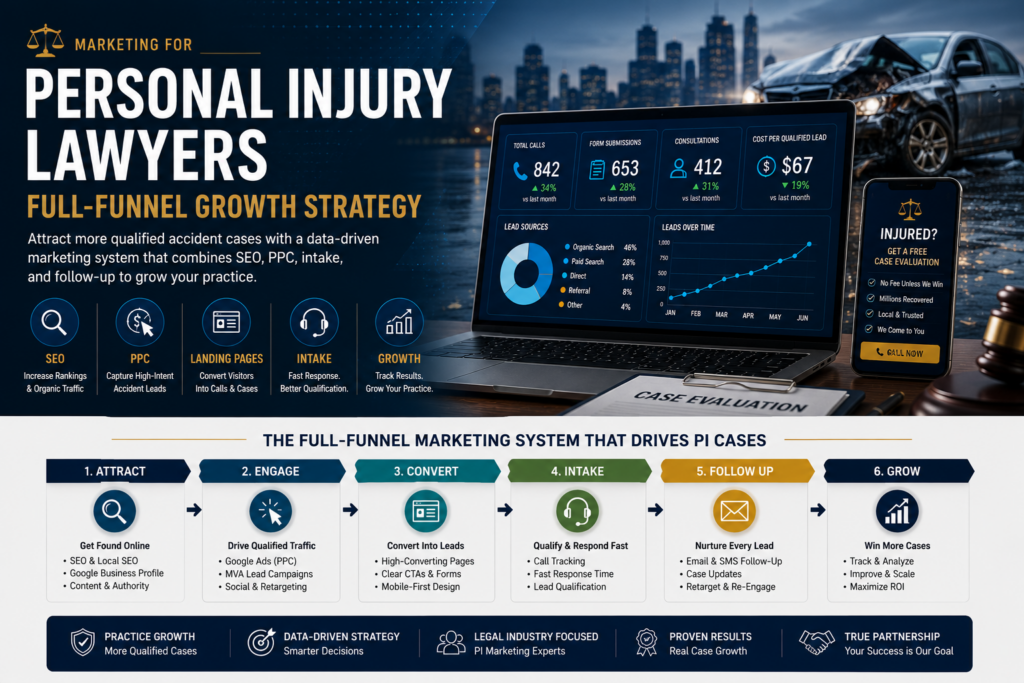
Marketing for personal injury lawyers is not simply about generating more leads. A personal injury firm can receive more calls, more form submissions, and more traffic while still struggling to sign the right cases. The real goal is to build a system that attracts qualified accident prospects, converts them quickly, and follows up before a valuable case goes to another firm.
Personal injury marketing is competitive because injured people often make decisions under pressure. They may be dealing with medical bills, insurance adjusters, pain, lost income, vehicle damage, and uncertainty about what to do next. Many will compare multiple attorneys in a short period of time.
That means a PI firm cannot rely on disconnected campaigns. SEO, PPC, landing pages, local visibility, intake, tracking, and follow-up need to work together. Strong personal injury lawyer marketing should be built around the entire journey from first search to qualified consultation.
PI Marketing Starts With Case Quality
The first mistake many firms make is chasing volume without defining quality. More leads are not automatically better if they are outside the firm’s target market, unrelated to injury cases, too small to pursue, already represented, or unlikely to become a strong opportunity.
A full-funnel strategy starts by defining the types of cases the firm actually wants. That may include car accidents, truck accidents, motorcycle crashes, pedestrian injuries, rideshare accidents, catastrophic injuries, wrongful death claims, or other high-value PI matters.
Once the firm knows what it wants more of, marketing can be built around those opportunities. Keywords, ads, landing pages, intake questions, and follow-up workflows should all support the firm’s preferred case mix.
SEO Builds Long-Term PI Visibility
SEO is one of the strongest long-term channels for personal injury firms, but it must be built with precision. A generic blog strategy is not enough.
Strong SEO for personal injury lawyers should include accident-focused keyword research, service page optimization, local SEO, technical SEO, internal linking, content clusters, Google Business Profile alignment, and conversion tracking.
The most important pages are often the firm’s core case-type pages. A PI firm should not rely only on one broad personal injury page. It may need dedicated pages for car accidents, truck accidents, motorcycle accidents, premises liability, dog bites, wrongful death, and other target case types.
Supporting blog content should answer real questions that injured prospects ask. Those articles should then link naturally back to the core pages, helping both users and search engines understand the firm’s authority.
PPC Captures High-Intent Demand Faster
SEO takes time. Paid search can help personal injury firms capture demand faster, especially for urgent accident searches.
Strong PPC for lawyers should focus on search intent, not raw clicks. A PI campaign should separate high-intent accident searches from research queries, competitor searches, low-value phrases, and irrelevant terms that waste spend.
The campaign should also use negative keywords, call tracking, conversion tracking, location targeting, and landing pages that match the searcher’s exact need. A person searching for a car accident lawyer should not land on a generic homepage. They should land on a page that speaks directly to accident urgency, injury concerns, insurance pressure, and next steps.
Paid search can work well for PI firms, but only when campaigns are measured by qualified opportunities, not just cost per lead.
Google Ads Should Connect to Landing Pages
Many PI firms lose money because their Google Ads campaigns send traffic to weak or generic pages. The ad may get the click, but the page does not build enough trust to earn the call.
Strong Google Ads for lawyers should connect the keyword, ad copy, landing page, CTA, tracking, and intake process. Every step should feel consistent to the prospect.
If the ad mentions car accidents, the landing page should focus on car accident help. If the ad mentions free case evaluation, the page should make that action clear. If the campaign targets a specific location, the page should support that local relevance.
A strong landing page should include a clear headline, concise explanation, trust signals, fast-loading mobile design, phone visibility, simple form, FAQs, and a direct CTA.
MVA Leads Need Better Qualification
Motor vehicle accident leads can be valuable, but not every MVA lead is worth the same level of attention. Some leads may involve no injury, no treatment, weak liability, poor location fit, or limited case potential.
That is why MVA leads for attorneys should be evaluated by quality, source, timing, response speed, and qualification criteria. The firm should know which campaigns produce strong conversations and which sources waste intake time.
A better MVA lead strategy includes accident-specific targeting, landing pages matched to crash intent, source tracking, intake questions, lead scoring, and follow-up workflows.
The goal is not just to collect more accident inquiries. The goal is to identify which accident inquiries deserve immediate attention and which sources produce better signed-case opportunities.
Personal Injury Leads Should Be Tracked by Source
PI firms often use multiple lead sources at once. They may invest in SEO, Google Ads, LSAs, referral campaigns, lead vendors, retargeting, social ads, and content marketing. Without tracking, it becomes difficult to know which sources are producing real value.
Strong personal injury leads strategy should include source attribution. The firm should know whether a lead came from organic search, paid search, a landing page, Google Business Profile, referral, retargeting campaign, or third-party source.
Lead quality should also be reviewed. A source that produces fewer but stronger inquiries may be more valuable than a source that produces many weak leads. Tracking should help the firm decide where to scale and where to cut waste.
Website Design Must Convert Fast
A personal injury prospect may be stressed, injured, and comparing options quickly. If the website is confusing, slow, outdated, or difficult to use on mobile, the firm can lose the inquiry before intake ever has a chance.
Strong law firm website design should support SEO, PPC, local search, trust, and conversion. The site should make it easy to understand who the firm helps, what types of cases it handles, why the firm is credible, and how to contact the team.
For PI firms, mobile experience is especially important. Many accident prospects search from their phones. The phone number, form, CTA, and key trust signals should be easy to find without friction.
The website should not function like a brochure. It should function like a conversion system.
Intake Speed Can Decide the Case
Personal injury prospects often contact more than one firm. If your team responds slowly, misses the call, or fails to follow up, another firm may win the opportunity.
That is why legal intake services are a critical part of personal injury marketing. Traffic and leads only matter if the firm can respond quickly, qualify properly, and move serious prospects toward consultation.
A strong intake process should include call tracking, form routing, response-time standards, qualification questions, CRM usage, lead source visibility, follow-up reminders, and escalation rules for high-value opportunities.
For PI firms, speed-to-lead is not a small operational detail. It is part of the marketing system.
Follow-Up Prevents Lost Opportunities
Not every prospect signs on the first contact. Some miss the first call. Some need more information. Some are still receiving medical treatment. Some are comparing firms. Some are overwhelmed and delay the decision.
A full-funnel PI marketing strategy should include follow-up. This may involve phone follow-up, SMS reminders, email nurture, consultation reminders, retargeting, and lead reactivation.
Follow-up should be professional, timely, and useful. The goal is not to pressure prospects. The goal is to stay visible and helpful while they decide what to do next.
When follow-up is missing, firms may pay to generate leads and then lose them because the process stops too early.
Retargeting Can Support the Decision Journey
Many personal injury prospects visit a website but do not contact the firm immediately. Retargeting can help the firm stay visible after that first visit.
Retargeting may support brand recall, trust-building, educational content, and consultation reminders. It can be especially useful when prospects are comparing multiple firms or need more time before taking action.
Retargeting should not replace SEO, PPC, or intake. It should support the broader funnel. The best campaigns reinforce the firm’s message and bring undecided visitors back to a relevant page.
Reporting Should Focus on Qualified Opportunities
A personal injury marketing report should not stop at clicks, impressions, rankings, or raw lead count. Those metrics matter, but they are incomplete.
A useful report should show which channels produced calls, forms, consultation requests, qualified leads, strong case conversations, and signed opportunities when available.
The firm should also evaluate page-level performance. Which service pages generate calls? Which landing pages convert best? Which keywords attract better prospects? Which campaigns produce poor-fit inquiries? Which sources deserve more budget?
Reporting should help the firm make better decisions. It should not just prove that activity happened.
Common PI Marketing Mistakes
One common mistake is relying on one channel only. SEO, PPC, intake, landing pages, and follow-up usually work better together.
Another mistake is sending paid traffic to generic pages. Personal injury prospects need pages that match accident intent, injury concerns, and local relevance.
A third mistake is judging campaigns by lead volume alone. More leads do not help if they are not qualified.
A fourth mistake is ignoring intake. Slow response can waste even the best marketing campaign.
A fifth mistake is publishing content without a keyword map. Blog posts should support service pages and case-type authority.
A sixth mistake is failing to track source quality. Without attribution, the firm may scale the wrong channels.
Build a Full-Funnel PI Growth System
The strongest personal injury marketing strategies connect the full funnel.
Search visibility attracts prospects. Paid ads capture urgent demand. Landing pages build trust. Website design supports conversion. Intake responds quickly. Lead scoring prioritizes better opportunities. Follow-up keeps prospects engaged. Reporting shows what to improve next.
This is how personal injury marketing becomes more than traffic generation. It becomes a case acquisition system.
Final Thoughts
Marketing for personal injury lawyers should be built around qualified case growth, not disconnected activity. A strong strategy should connect SEO, PPC, local visibility, landing pages, MVA lead strategy, website conversion, intake, follow-up, and reporting.
The firms that win are not always the firms with the most leads. They are often the firms with the clearest funnel, fastest response, strongest trust signals, and best understanding of lead quality.
If your PI firm wants a full-funnel marketing system built around better case opportunities, Apply for your FREE Discovery Call with LawProNation.
FAQs
What is marketing for personal injury lawyers?
Marketing for personal injury lawyers is the strategy used to attract, convert, qualify, and follow up with potential injury clients through SEO, PPC, landing pages, local search, intake, tracking, and lead generation.
What marketing channels work best for personal injury lawyers?
Strong channels can include SEO, Google Ads, Local Service Ads, retargeting, local SEO, landing pages, MVA lead campaigns, referral systems, and intake follow-up. The best mix depends on the firm’s market and case goals.
Why is personal injury marketing so competitive?
Personal injury marketing is competitive because accident cases can be valuable and many firms compete aggressively for the same local, high-intent searches.
Should PI firms focus on SEO or PPC?
Many PI firms benefit from both. SEO builds long-term visibility, while PPC can capture urgent demand faster. Both should be connected to strong landing pages and intake tracking.
How can personal injury firms improve lead quality?
PI firms can improve lead quality by targeting better keywords, using focused landing pages, tracking lead sources, qualifying inquiries, improving intake questions, and following up quickly.
Why does intake matter in PI marketing?
Intake matters because injured prospects often contact multiple firms. Fast response, clear qualification, and consistent follow-up can help prevent valuable opportunities from being lost.
How does LawProNation help personal injury lawyers market better?
LawProNation connects SEO, PPC, landing pages, MVA lead strategy, website conversion, intake, tracking, and follow-up into a Case Attraction System™ built for personal injury firms.