

Choosing between legal marketing firms can feel difficult because many agencies promise the same things. They talk about more leads, better rankings, stronger ads, improved websites, and increased visibility. But for law firms, the real question is not which agency sounds the most impressive. The real question is which agency can connect marketing activity to qualified consultations and signed-case growth.
A law firm does not need another vendor sending reports full of clicks, impressions, and surface-level metrics. Attorneys need a strategy that improves visibility, builds trust, converts traffic, supports intake, and helps the firm understand which marketing sources produce meaningful opportunities.
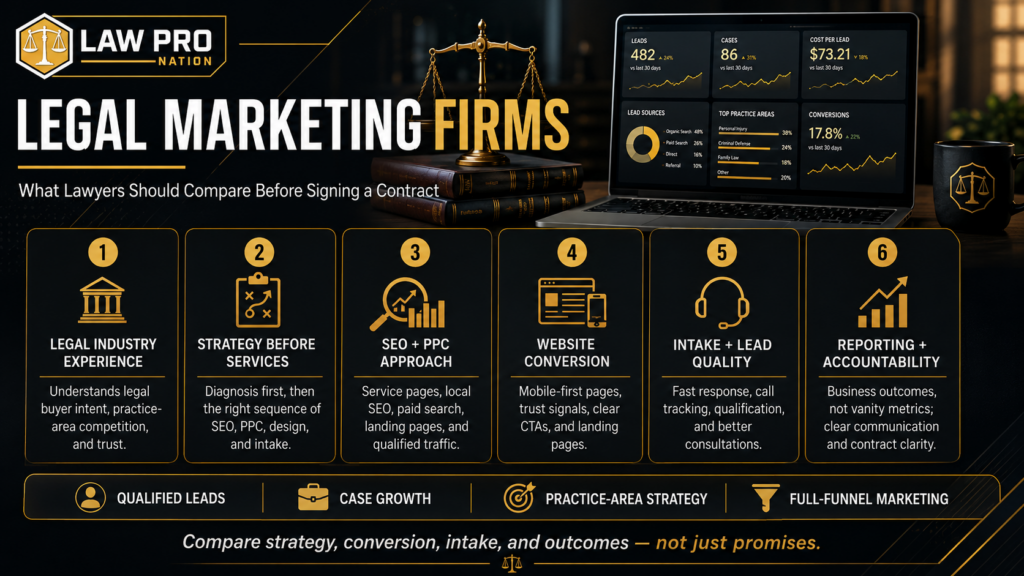
That is why lawyers should compare legal marketing firms based on strategy, specialization, reporting, lead quality, intake alignment, and execution depth. A strong law firm marketing agency should operate as a growth partner, not just a campaign manager.
Compare Legal Industry Experience First
The first thing attorneys should compare is whether the agency understands legal marketing. Marketing a law firm is different from marketing a restaurant, contractor, SaaS company, ecommerce store, or medical practice.
Legal prospects often make high-stakes decisions. They may be injured, stressed, facing deadlines, comparing multiple firms, or unsure whether they have a case. They need trust, clarity, and a fast path to the next step.
Legal marketing firms should understand attorney search behavior, local competition, practice-area intent, compliance-sensitive messaging, intake response, and lead quality. If an agency uses the same strategy for every industry, it may not understand what makes legal marketing different.
This matters even more in competitive areas like personal injury, where a visitor may contact several firms within a short window. A generic agency may focus on traffic, while a legal-focused agency should focus on whether that traffic can become a qualified legal opportunity.
Compare Strategy Before Comparing Services
Many firms compare agencies by looking at service lists. One agency offers SEO, another offers PPC, another offers website design, and another offers social media. But a service list does not tell you whether the agency has a strategy.
A serious legal marketing firm should begin with diagnosis. It should review your market, website, rankings, ad campaigns, lead sources, intake process, conversion paths, competitors, and business goals before recommending a plan.
For example, if your website gets traffic but does not convert, the first priority may be landing pages or website improvements. If your site has weak organic visibility, the priority may be law firm SEO services. If you need immediate high-intent traffic, paid search may make sense. If you are missing calls, intake may need attention before more ad spend is added.
The best legal marketing firms do not sell the same package to every lawyer. They recommend the right sequence of work based on the firm’s real growth constraints.
Compare SEO Approach
SEO is often one of the biggest differences between legal marketing firms. Some agencies treat SEO as monthly blog publishing. Others understand that law firm SEO requires service pages, local SEO, technical cleanup, internal linking, content clusters, Google Business Profile optimization, reviews, and conversion tracking.
Lawyers should ask how the agency decides which keywords deserve service pages and which deserve blog posts. This question matters because not every keyword should become an article. Some keywords are commercial and should be targeted by core pages. Others are educational and should support those pages.
A legal marketing firm should also explain how SEO connects to business outcomes. Rankings are useful, but the more important question is whether organic search is producing qualified calls, forms, consultations, and signed-case opportunities.
For personal injury firms, SEO should be even more specific. Strong SEO for personal injury lawyers should prioritize accident intent, local relevance, high-value case types, service page depth, and intake readiness.
Compare Paid Search Management
Paid search can generate faster visibility, but it can also waste money quickly if it is not managed properly. Attorneys should compare how legal marketing firms approach PPC, Google Ads, negative keywords, landing pages, call tracking, and lead quality.
A weak agency may focus on clicks and cost per lead. A stronger agency will ask whether those leads are qualified, whether calls are answered, whether the landing pages match search intent, and whether the campaign is producing realistic case opportunities.
Strong PPC for lawyers should be structured around legal search intent, not broad traffic. The agency should separate urgent hiring searches from research terms, exclude irrelevant traffic, and use landing pages that match the specific legal issue.
The same applies to Google Ads for lawyers. Google Ads should not operate in isolation. It should connect to intake feedback, call tracking, lead source data, and conversion optimization.
Compare Website and Landing Page Strategy
A law firm website is not just a design asset. It is the center of the firm’s digital marketing system. SEO, PPC, referral traffic, retargeting, email, and social proof all eventually depend on the website’s ability to convert visitors.
Legal marketing firms should be compared based on how they approach website strategy. Do they understand service page structure? Do they build mobile-first pages? Do they improve CTAs? Do they add trust signals? Do they create landing pages for paid campaigns? Do they connect forms and calls to tracking?
Strong law firm website design should support both search visibility and conversion. A website can look modern and still fail if the visitor does not understand what to do next.
A serious agency should be able to explain how website improvements support lead generation, not just visual branding.
Compare Intake Alignment
One of the most important things lawyers should compare is whether the marketing firm understands intake. Many agencies stop measuring success when a form is submitted or a call is generated. But for a law firm, that is not the end of the process. It is the beginning of conversion.
If a lead is not answered quickly, routed properly, qualified correctly, or followed up with consistently, marketing performance suffers. The firm may think it has a lead problem when it actually has an intake problem.
A legal marketing firm should ask about response time, missed calls, form follow-up, call scripts, lead qualification, CRM usage, lead source tracking, and consultation booking. Strong legal intake services can help turn marketing activity into better consultation opportunities.
If an agency never asks what happens after the lead arrives, it may not be equipped to help the firm improve real conversion.
Compare Lead Quality, Not Just Lead Volume
More leads do not always mean better growth. A law firm can receive many inquiries that are outside the practice area, outside the target location, too small to pursue, already represented, or not ready to act.
Legal marketing firms should be compared based on how they evaluate lead quality. Do they track source quality? Do they ask which leads became consultations? Do they identify which campaigns produce serious prospects? Do they use intake feedback to improve strategy?
This is especially important for firms investing in personal injury leads or MVA leads for attorneys. Accident lead generation should be judged by quality, timing, exclusivity, qualification, and signed-case potential, not just raw volume.
An agency that only reports lead count may encourage the firm to keep spending on sources that waste time.
Compare Reporting Quality
Marketing reports should help attorneys make better decisions. Unfortunately, many reports are designed to look impressive without explaining what matters.
A useful report should connect activity to outcomes. It should show rankings, traffic, paid search performance, call volume, form submissions, landing page conversions, lead sources, consultation requests, and lead quality indicators whenever possible.
The report should also explain what changed and what should happen next. If the agency sends a dashboard without strategic interpretation, the firm may still be left guessing.
Lawyers should ask each agency what reporting includes, how often strategy is reviewed, and whether the agency can separate vanity metrics from meaningful performance indicators.
Compare Communication and Accountability
Communication matters because law firm marketing requires ongoing decisions. Campaigns change, competitors respond, search results shift, ads need refinement, intake feedback evolves, and new opportunities appear.
A good legal marketing firm should provide clear communication, realistic timelines, and specific next steps. It should be willing to explain what is working, what is not working, and what needs adjustment.
Be cautious with firms that are vague, overly automated, or difficult to reach after the contract is signed. Marketing is not a set-it-and-forget-it activity. Your agency should act like a partner with accountability.
Compare Contract Terms Carefully
Before signing, attorneys should review the contract carefully. Important items may include contract length, cancellation terms, ownership of website assets, ownership of ad accounts, ownership of landing pages, content rights, reporting access, tracking access, and what happens if the relationship ends.
A law firm should avoid being trapped in an arrangement where it does not own its website, data, content, or ad account. The firm should also understand exactly what is included in the monthly fee and what costs extra.
If the agency’s agreement is unclear, ask questions before signing. A trustworthy firm should be able to explain the terms plainly.
Compare Specialization by Practice Area
Not every law firm needs the same marketing strategy. Personal injury, criminal defense, family law, immigration, estate planning, employment law, business law, and mass tort campaigns can require different keyword strategies, page structures, offers, and intake processes.
A personal injury firm may need accident-specific SEO, MVA lead generation, Google Ads, fast intake, and strong local visibility. A family law firm may need content that builds trust around sensitive decisions. A criminal defense firm may need urgent local search visibility and strong mobile conversion.
A legal marketing firm should understand how strategy changes by practice area. If every client receives the same plan, the agency may not be thinking deeply enough.
Compare Whether the Agency Connects the Full Funnel
The strongest legal marketing firms connect the full funnel. They do not treat SEO, PPC, website design, intake, content, and reporting as separate silos.
SEO builds long-term visibility. PPC creates faster demand capture. Website design improves conversion. Landing pages match campaign intent. Intake turns inquiries into consultations. Reporting identifies what deserves more investment. Follow-up keeps prospects from going cold.
When these pieces work together, the firm gets a clearer growth system. When they are disconnected, the firm may spend money on activity without understanding what drives results.
LawProNation calls this broader approach the Case Attraction System™: a strategy that connects visibility, trust, conversion, intake, and follow-up into a more predictable growth path.
Final Thoughts
Legal marketing firms may look similar on the surface, but the differences become clear when attorneys compare strategy, specialization, reporting, intake alignment, lead quality, and accountability.
The right agency should understand legal search intent, build strong service pages, manage paid search carefully, improve website conversion, connect marketing to intake, and report on business outcomes rather than vanity metrics.
If your firm wants a growth partner that connects marketing activity to qualified legal opportunities, Apply for your FREE Discovery Call with LawProNation.
FAQs
What do legal marketing firms do?
Legal marketing firms help attorneys attract and convert potential clients through services such as SEO, PPC, website design, content marketing, landing pages, intake strategy, lead generation, and tracking.
How should lawyers compare legal marketing firms?
Lawyers should compare legal marketing firms based on legal industry experience, strategy, SEO approach, PPC management, website conversion, intake alignment, reporting, lead quality, and contract terms.
Should law firms choose a specialized legal marketing agency?
A specialized legal marketing agency is often better because it understands attorney search intent, legal competition, practice-area marketing, intake response, and qualified lead generation.
What should be included in legal marketing reporting?
Legal marketing reporting should include rankings, traffic, paid search performance, calls, forms, consultation requests, landing page conversions, lead source, response time, and lead quality indicators.
Why does intake matter when comparing legal marketing firms?
Intake matters because marketing only creates opportunities. The firm must respond quickly, qualify leads properly, and follow up consistently to turn inquiries into consultations and signed cases.
Are more leads always better for law firms?
No. More leads are only useful if they are qualified, relevant, timely, and aligned with the firm’s practice areas and case goals.
How does LawProNation compare to other legal marketing firms?
LawProNation connects SEO, PPC, website design, intake, lead generation, tracking, and follow-up into a full Case Attraction System™ focused on qualified legal opportunities.